The Science of Softening Your Scars

Scar tissue massage therapy uses targeted pressure and movement to improve flexibility and appearance. Discover the science behind this hands-on technique and how to do it effectively.
What Is Scar Tissue Massage Therapy — and Does It Work?
Scar tissue massage therapy is a hands-on technique that uses targeted pressure and movement to improve the flexibility, appearance, and function of scar tissue after surgery or injury.
Here is what the evidence currently shows:
| Question | Short Answer |
|---|---|
| When to start | Once the wound is fully closed — typically 2-3 weeks post-surgery |
| How often | Trials used 5-30 minutes, 1-3 times per week; more frequent regimens are untested |
| How long | About 12 weeks in the trials; no study has tested beyond 6 months |
| Key benefit | Moderate evidence for reducing pain and itching; weak evidence for changing pliability, thickness or adhesions |
| Main techniques | Circular, linear, and cross-friction strokes |
| When to stop | During active radiation therapy or if skin is open or inflamed |
Scars are not simply cosmetic. Beneath the surface, scar tissue is structurally different from healthy skin — it is less elastic, less well-supplied with blood, and prone to sticking to underlying layers of muscle and fascia. This can cause tightness, restricted movement, and ongoing discomfort long after the original wound has healed.
For many people — particularly those recovering from breast cancer surgery, orthopedic procedures, or significant skin injuries — these physical restrictions become a real quality-of-life issue.
The encouraging reality is that scar tissue is living tissue. It continues to remodel itself for months, sometimes years, after injury. Research suggests that targeted massage may support this remodeling process by improving collagen alignment, increasing local circulation, and reducing the formation of adhesions.
A 2023 review examining seven clinical trials and 420 burn patients found that scar massage was associated with measurable reductions in pain, scar thickness, itching, and anxiety — though the authors noted that study designs varied and further research is needed to establish optimal protocols.
This article explains the biology behind scar formation, reviews the current evidence for massage therapy as a management tool, and provides practical, science-informed guidance on technique, timing, and safety.
This content is for informational purposes only and does not constitute medical advice. Consult a qualified healthcare professional for diagnosis and treatment.
Key terms for scar tissue massage therapy:
How scars form
To understand why scar tissue massage therapy is effective, one must first understand how the body repairs itself. When the dermis (the deep layer of the skin) is damaged, the body initiates a rapid repair mission. This process is less about "regeneration" and more about "patching."
Healthy skin is composed of collagen fibers arranged in a flexible, "basket-weave" pattern. This structure allows the skin to stretch in multiple directions. However, during the proliferative phase of wound healing, the body produces collagen in a hurried, haphazard fashion. According to a literature review on wound healing, these new fibers often align in a single, parallel direction.
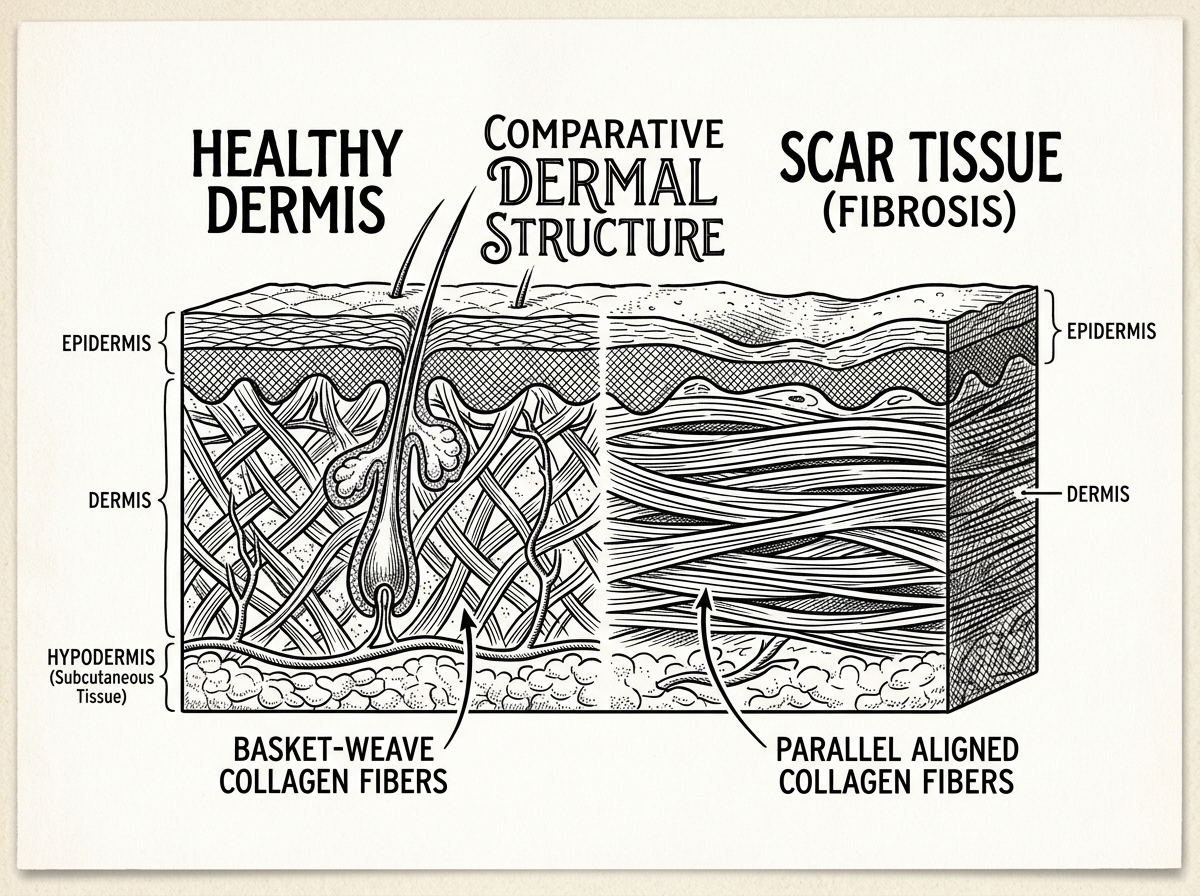
This parallel alignment results in tissue that is structurally inferior to the original skin. It lacks hair follicles and sweat glands. Because these fibers are densely packed and lack elasticity, they can form "adhesions"—internal bonds where the scar "sticks" to underlying muscles, tendons, or fascia. This biological reality is the primary reason why more info about scar healing is essential for those experiencing post-surgical tightness.
How massage helps recovery
The application of mechanical force to a scar is not just about comfort; it involves a biological process called mechanotransduction. This is the way cells convert mechanical stimuli (like the pressure from a thumb) into chemical signals. When a therapist or patient applies pressure, it signals the fibroblasts—the cells responsible for collagen production—to remodel the tissue.
Research indicates that scar tissue massage therapy helps prevent tissue hypoxia (lack of oxygen) by stimulating microcirculation. A systematic review and meta-analysis on burn scars measured pain, scar thickness, itching, anxiety and depression — not pliability — and reported significant reductions in pain, thickness, itching and anxiety. By physically moving the skin over the underlying structures, the massage "breaks" the small cross-links of collagen that cause adhesions, allowing the different layers of tissue to slide and glide against each other once more.
What massage can and cannot do
Clinical observations and peer-reviewed studies highlight several key benefits of consistent scar mobilization:
- Improved Pliability: Massage helps soften the "hard" feeling of a scar, making it more flexible and less prone to cracking or reopening.
- Pruritus (Itching) Reduction: By modulating the nerve endings in the area and improving hydration, massage can decrease the intense itching often associated with maturing scars.
- Increased Range of Motion: Mobilizing scars that cross joints (like the knee or shoulder) prevents the tissue from shortening and restricting movement.
- Pain Desensitization: New scars are often hypersensitive. Gentle, repetitive touch helps the nervous system habituate to sensation, reducing pain over time.
- Collagen Realignment: Mechanical pressure encourages collagen fibers to move from a random, tangled state into a more organized, functional alignment.
That list needs an honest counterweight. The best-designed trial in this field — a randomized controlled trial in 60 adults with burn scars that massaged one scar three times a week for 12 weeks while a matched scar on the same person was left untreated — found no evidence of long-term benefit, and its authors concluded that massage therapy applied with the objective of increasing scar elasticity should be reconsidered. The 2012 literature review listed among this article’s sources reached the same place from a different direction: the evidence for the use of scar massage is weak, the regimens studied vary widely, and the outcomes measured are neither standardized nor reliably objective.
So it is worth being precise about what is and is not supported. For symptom relief — pain and itching — the evidence is moderate: the meta-analysis cited above found significant reductions in both. For changing the scar itself — its pliability, its thickness, whether it forms adhesions — the evidence is weak: the trial that tested it most rigorously was negative, and the reviews that looked across the literature judged the underlying studies too varied and too poorly measured to settle the question. Massage is a reasonable thing to try for comfort. It is not a proven way to remodel a scar.
Doing scar massage at home
While professional therapy is highly beneficial, much of the work in scar remodeling happens through consistent daily self-care. Professionals generally recommend the following guidelines for home-based care:
- Pressure — Build It Gradually: On a young scar, keep the touch light. Once the scar is fully closed, intact and no longer inflamed, you can work deeply enough that the skin under your finger turns white (blanches) and then pink again when you let go — that depth tells you that you are moving the deeper layers rather than sliding over the surface. Build up to it over weeks rather than starting there, stop short of pain, and ease off entirely if the scar becomes inflamed or breaks down.
- Duration and Frequency: In the trials this article draws on, sessions ran 5 to 30 minutes, one to three times per week, for about 12 weeks. Daily or twice-daily routines are common clinical advice, but no trial has tested them.
- Consistency: The remodeling phase of a scar can last up to two years, but the trials are far shorter: published regimens run to about 12 weeks, and no located study followed massage beyond six months. Anything longer is untested rather than recommended.
- Warmth: Massage is often more effective when the skin is warm, such as after a shower, as the heat increases tissue extensibility.
For those looking to deepen their understanding of long-term care, seeking more info about scar healing can provide additional strategies for managing complex scars.
Techniques that soften scars
Professional massage therapists and physical therapists utilize specific strokes designed to target different aspects of the scar's structure.
- Cross-Friction (Transverse Friction): This involves moving the finger pads perpendicular to the line of the scar. This technique is specifically designed to prevent or break down adhesions between the scar and the underlying muscle or bone.
- Circular Mobilization: Using the pads of the fingers, the therapist makes small, firm circles over the entire length of the scar and the surrounding skin. This helps "loosen" the tissue in all directions.
- Linear Strokes: These are firm strokes moving along the length of the scar. This helps to lengthen the tissue, which is particularly important for scars that feel "tight" or "short."
- Myofascial Release: This involves applying a gentle, sustained stretch to the skin adjacent to the scar to restore the "slide and glide" of the fascial layers.
- Trigger Pointing and Acupressure: In some cases, therapists apply sustained pressure to specific "knots" or sensitive points within the scar. This can induce an ischemic reaction—where blood is briefly pushed out and then floods back in—which helps soften the tissue.
Research into instrument-assisted soft tissue mobilization (IASTM) shows that using specialized tools can also be effective.
Specialized Approaches for Surgical Recovery
Different surgeries require tailored approaches to scar tissue massage therapy:
- Breast Cancer Surgery: Massage is vital for scars on the chest and armpit to prevent "cording" (axillary web syndrome) and to maintain shoulder mobility.
- Kidney Transplant: Abdominal scars can affect core strength and even breathing if they become too restrictive. Massage helps maintain the flexibility of the abdominal wall.
- C-Section: Massage here works on the abdominal wall — the skin, fat and fascia you can actually reach. A 2026 systematic review of cesarean scar rehabilitation supports manual therapy for those superficial layers and for adhesion-related symptoms, but states plainly that direct mechanotherapy for scarring inside the uterus remains unproven. Massage should not be expected to stop the scar adhering to the bladder or uterus.
- Orthopedic Incisions: For knee or hip replacements, massage ensures the scar doesn't "tether" the joint, which would limit the success of the replacement.
Safety and when to avoid it
Safety is paramount when working with healing tissue. Massaging a wound too early can lead to infection or cause the wound to reopen (dehiscence).
The "Ready" Signals: Before beginning scar tissue massage therapy, ensure the wound is fully epidermized. This means there are no open areas, no oozing, no scabs, and all stitches or staples have been removed. This usually occurs 2 to 3 weeks after the initial injury or surgery.
When to Avoid Massage:
- Too Much Force: Force is a limit, not just a technique. Current burn-rehabilitation guidance states that forceful scar massage should be avoided early in the wound healing process, or when the scar is inflamed or breaks down. Start light, build pressure gradually as the scar matures, and never work into pain.
- Infection: If the area is hot, excessively red, swollen, or draining fluid, stop immediately and consult a doctor.
- Radiation Therapy: Skin that is currently undergoing radiation is extremely fragile. Massage should be paused during treatment and only resumed once the skin has fully recovered, as advised by an oncologist.
- Inflammatory Stage: During the very first few days of healing, the tissue is too weak for deep pressure.
- Fragile Epidermis: If the skin is paper-thin or prone to blistering, only the gentlest touch should be used.
For those prone to keloids and hypertrophic scars, professional guidance is essential, as aggressive massage can sometimes trigger further collagen overproduction in these specific scar types.
Frequently Asked Questions about Scar Management
When is it safe to begin scar massage after surgery?
The general clinical consensus is to wait until the wound is completely closed. This typically means all scabs have fallen off naturally and any sutures or staples have been removed. For most surgical patients, this window opens between 14 and 21 days post-operation. Always obtain clearance from your surgeon before starting.
Can massage therapy improve the appearance of mature scars?
The "maturation phase" of a scar lasts between 12 and 24 months. During this window, the tissue is still actively remodeling and is quite responsive to massage. Once a scar is "mature" (usually white, flat, and older than two years), it is less likely to change significantly in appearance. However, massage can still help improve the flexibility of the surrounding skin and reduce any lingering tightness.
What lubricants are recommended for scar mobilization?
In the clinical setting, some therapists prefer "dry" techniques to ensure they have a firm grip on the tissue, allowing them to move the scar rather than just sliding over the skin. However, for home use, lubrication can prevent irritation.
- Recommended: Fragrance-free moisturizers, plant oils (like jojoba or almond oil), or silicone-based gels.
- Avoid: Heavily perfumed lotions or products with "miracle" claims that haven't been peer-reviewed.
Conclusion
The journey of healing does not end when the stitches come out. Scar tissue is a dynamic, living part of the body that requires ongoing care to reach its most functional state. By understanding the science of scar tissue massage therapy, patients can take an active role in their recovery, moving from a state of restriction to one of mobility.
While the physical changes—a flatter, softer, or paler scar—are often the most sought-after, the improvements in quality of life are the most significant. Reducing pain, regaining the ability to reach into a cupboard, or simply feeling "at home" in one's skin again are the true goals of scar management. For continued education and resources, visiting more info about scar healing can empower patients with the latest evidence-based strategies.
This content is for informational purposes only and does not constitute medical advice. Consult a qualified healthcare professional for diagnosis and treatment.
Works Cited
- Shin, T. M., & Bordeaux, J. S. (2012). The role of massage in scar management: a literature review. Dermatologic Surgery, 38(3), 414–423. https://pubmed.ncbi.nlm.nih.gov/22093081/
- Lubczyńska, A., Garncarczyk, A., & Wcisło-Dziadecka, D. (2023). Effectiveness of various methods of manual scar therapy. Skin Research and Technology, 29(3), e13272. https://pubmed.ncbi.nlm.nih.gov/36973982/
- Cho, Y. S., et al. (2014). The effect of burn rehabilitation massage therapy on hypertrophic scar after burn: a randomized controlled trial. Burns, 40(8), 1513–1520. https://pubmed.ncbi.nlm.nih.gov/24630820/
- Lin, T. R., et al. (2023). Effects of scar massage on burn scars: A systematic review and meta-analysis. Journal of Clinical Nursing, 32(13-14), 3144-3154. https://pubmed.ncbi.nlm.nih.gov/35758338/
- Monstrey, S., et al. (2014). Updated scar management practical guidelines. Journal of Plastic, Reconstructive & Aesthetic Surgery, 67(8), 1017–1025. https://pubmed.ncbi.nlm.nih.gov/24888226/
- Nedelec, B., et al. (2019). Randomized controlled trial of the immediate and long-term effect of massage on adult postburn scar. Burns, 45(1), 128–139. https://pubmed.ncbi.nlm.nih.gov/30626496/
- Edger-Lacoursière, Z., et al. (2025). Evidence supporting conservative scar management interventions following burn injury: a review article. Journal of Burn Care & Research, 46(3), 504–514. https://pubmed.ncbi.nlm.nih.gov/39548761/
- Zhou, Y., Huang, J. Y., & Shi, W. (2026). From mechanics to mobilization: a biomechanically-informed rehabilitation framework for cesarean-related scars. BMC Women’s Health, 26(1). https://pubmed.ncbi.nlm.nih.gov/42477704/