Scar massage
Scar massage is cheap, low-risk and best supported for burn scars. The trial evidence is thinner than the confidence with which it is usually recommended.
Does it work?
Massage is the most widely recommended thing you can do to a scar yourself, and the evidence behind it is more mixed than that suggests. The strongest finding is burn-specific: a 2025 network meta-analysis in PLOS One, drawing on 17 randomized trials in 1,013 people, ranked massage highest for improving overall scar quality, while ranking fractional CO2 laser highest for reducing thickness. Its authors caution that the ranking reflects one stage of scar maturation and rests on a limited number of studies. A 2023 review of seven trials and 420 burn patients found reductions in pain, thickness, itch and anxiety. Against that, the best-designed single trial in the field, a randomized controlled trial in 60 adults where one burn scar was massaged three times a week for 12 weeks and a matched scar on the same person was not, is reported in our own corpus as showing no significant difference. Massage costs nothing and carries almost no risk, which is a good reason to do it and not a reason to overstate it.
- Best for
- Burn and surgical scars: pliability, pain and itch. Not for atrophic scars, where our corpus has nothing at all.
- Typical course
- Trial protocols ran 5 to 30 minutes, one to three times per week, for about 12 weeks. Common clinical advice is 5 to 10 minutes, two to three times daily, for up to six months.
- Evidence strength
- Moderate for burn scars, on a network meta-analysis and a seven-trial review. Limited for surgical and other scars. The burn evidence includes one negative randomized trial.
- Cost
- Nothing, if you do it yourself. The cost is the months of daily minutes it asks for.
Which scars it works on
| Scar type | Evidence | Expected result | |
|---|---|---|---|
| Burn scars | Moderate | The best-studied application. A 2025 network meta-analysis of 17 randomized trials in 1,013 people ranked massage highest for overall scar quality among non-surgical options in burn scars, on a ranking its authors ask to be read with caution. A 2023 review of seven trials and 420 patients found reductions in pain, thickness, itch and anxiety. | Hub → |
| C-section scars | Limited | Helps mobilize a tethered line and the tissue immediately under it. It should not be expected to affect internal adhesions between organs: a 2026 systematic review cited in our corpus does not support that claim. | Hub → |
| Contracture scars | Limited | Used alongside stretching, positioning and splinting to maintain pliability and loosen adhesions while a scar is still active. It does not restore length once skin is gone. | Hub → |
| Hypertrophic scars | Limited | Permitted with caution on hypertrophic scars once they are no longer red, inflamed or easily irritated. Forceful friction on an active raised scar can worsen irritation. | Hub → |
| Keloid scars | Limited | Permitted with caution on hypertrophic scars once they are no longer red, inflamed or easily irritated. Forceful friction on an active raised scar can worsen irritation. | Hub → |
| Surgical and incision scars | Limited | In one reviewed study, 90% of surgical scars showed improved appearance or POSAS scores after massage. A review of ten publications covering 144 patients found 45.7% had measurable improvement in appearance, pain, itch or range of motion. | Hub → |
How it works
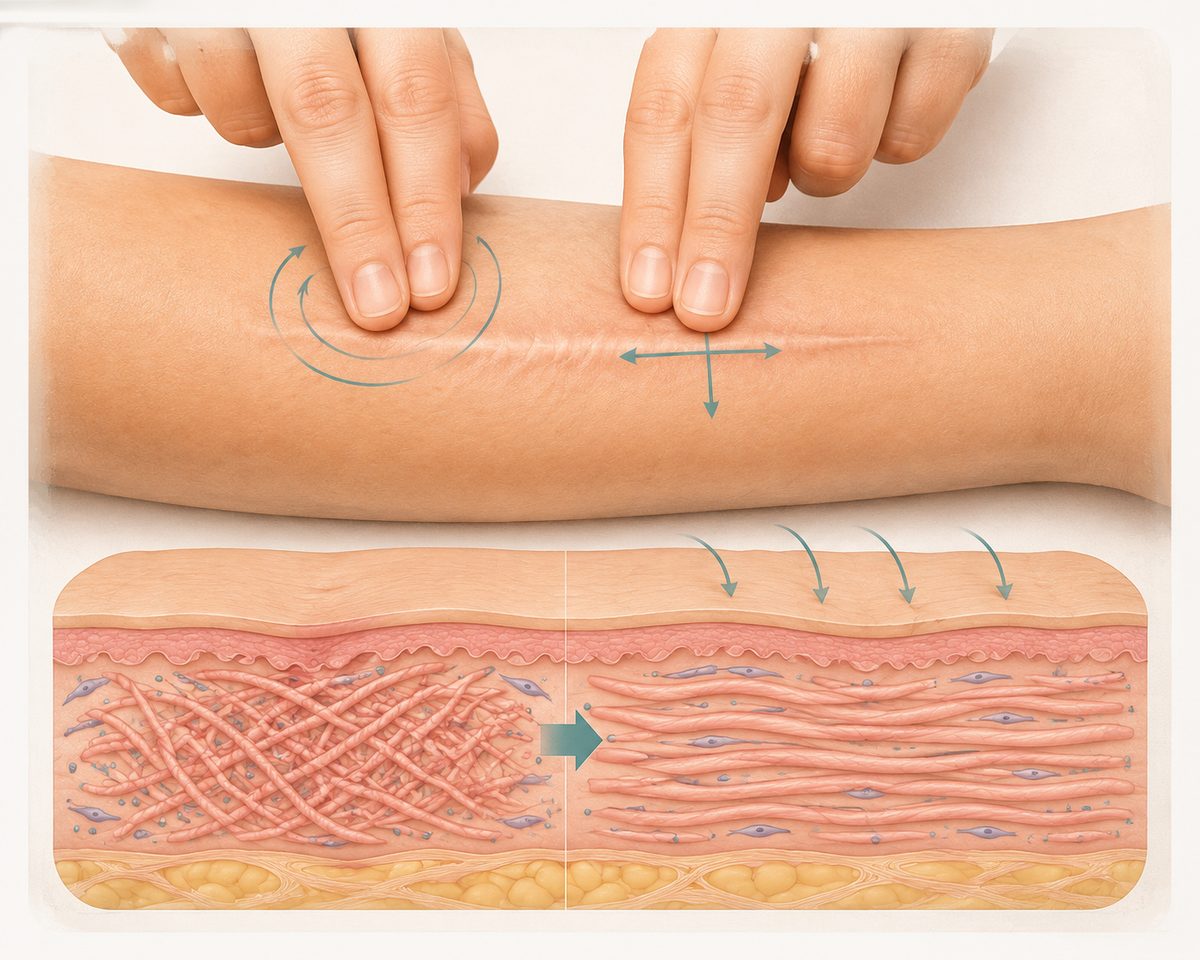
Massage is mechanotransduction: mechanical load on tissue becomes a biochemical signal inside the cells. Pressure and shear across a scar deform fibroblasts, collagen bundles reorient along the direction of loading, adhesions between the scar and the layers beneath it loosen, and circulation improves in tissue that is normally poorly supplied. Repeated touch also desensitizes hypersensitive nerve endings, so itch and tenderness often ease well before appearance changes. One tension in this account is unresolved in our corpus. Every mechanotransduction pathway our articles describe, YAP and TAZ signaling, focal adhesion kinase, piezo channels and the verteporfin work, describes mechanical load driving fibrosis, and the therapeutic idea now being explored is to block it. The massage articles claim hand-applied load reduces fibrosis. Both may hold at different magnitudes and durations of force, but nothing in our sources demonstrates that.
What to expect
Start once the wound is fully closed with no scabs and sutures out, typically 2 to 4 weeks after injury or surgery. Use finger pads, not nails, with a plain unscented moisturizer or a silicone product so the skin does not drag. Work in small circles, then along the scar, then across it. Pressure should be firm enough to move the scar against the tissue underneath, which is the point, and it should feel like pressure, never sharp pain. Stop if the skin blisters, reddens badly or opens. On duration our sources split: the trials this evidence rests on ran 5 to 30 minutes, one to three times per week for about 12 weeks, while common clinical advice is 5 to 10 minutes two to three times daily for up to six months. That is a twenty-fold difference in dose. Neither is unreasonable.
Risks and downsides
Review before treatment
- Not on an open or unhealed wound. Wait for full closure, typically 2 to 4 weeks.
- Not over skin that is currently being irradiated, or over an area that is inflamed, hot or broken.
- Too much force too early can disrupt fragile new tissue. Scar tissue reaches only about 70% to 80% of the strength of normal skin, so it is more vulnerable during the first year.
- On an active red hypertrophic scar, forceful cross-friction can increase irritation. Wait until it has calmed.
- Six months of daily massage on a scar that needed a procedure is six months of the remodeling window spent.
Compared with the alternatives
vs. Silicone gel and sheets
They do different jobs and are usually used together. Silicone manages hydration and occlusion passively; massage applies mechanical load. Massaging a silicone product in, instead of laying it on is the standard way to get both, and it costs nothing extra.
vs. Fractional CO2 laser
The same network meta-analysis that ranked massage highest for overall burn scar quality ranked fractional CO2 highest for reducing thickness. If the problem is a thick, rigid scar, that is a laser problem. If the problem is pliability, symptoms and general quality, massage carries real weight.
vs. Pressure garments
Both are mechanical and both are used in burn rehabilitation, usually alongside each other. Garments apply continuous low pressure across large areas for months; massage applies intermittent higher force to a specific scar.
Common questions
Two answers, and they differ by a factor of twenty. The trials this evidence rests on used sessions of 5 to 30 minutes, one to three times per week, for about 12 weeks. Standard clinical advice is 5 to 10 minutes, two to three times a day. The tested protocol is the weekly one. Most therapists will tell you daily, and daily is not known to be harmful, but you should know which of those is evidence and which is practice.
It should not be expected to. Massage affects the scar and the layers immediately beneath it. A 2026 systematic review cited in our corpus does not support the claim that it restores glide between internal organs such as the bladder and uterus. One of our own articles states otherwise and is being corrected.
Our corpus contains no massage content for atrophic or acne scarring at all. That is a gap in the corpus, not a negative finding, but mechanically there is little reason to expect it: massage reorganizes collagen and loosens adhesions, and an atrophic scar is missing tissue.
Once the wound is fully closed, no scabs, sutures out, which is typically 2 to 4 weeks after injury or surgery. Starting earlier risks disrupting new tissue. If the scar is from a burn and you are under a therapy team, follow their timing over any general figure.