Laser treatment for scars
Clinical trials treat 50% to 75% improvement in texture, height and color as a strong laser outcome. The scar becomes flatter and paler.
Does it work?
Laser is the most studied procedural option for scars, and the results hold up when the device is matched to the scar. Pulsed dye laser cuts redness and height in raised scars. The 57% to 83% improvement figure quoted for it comes from one early case series of 14 patients given one or two sessions, in erythematous and hypertrophic scars and not keloids, so read it as indicative rather than settled. Fractional CO2 rebuilds texture in pitted acne scars and softens thick burn scars. Trials usually define success as 50% to 75% improvement. Darker skin can be treated safely, with longer wavelengths and conservative settings.
- Best for
- Red raised scars (pulsed dye), pitted acne and chickenpox scars, and thick or movement-limiting burn scars (fractional CO2).
- Typical course
- 3 to 6 sessions, spaced 4 to 8 weeks apart. Final remodeling shows 6 to 12 months after the last session.
- Evidence strength
- Strong for atrophic acne scars. Moderate for hypertrophic, burn, surgical, C-section, chickenpox and contracture scars, and low-certainty for keloids. Limited for stretch marks.
- Cost
- Roughly $400 to $1,445 per non-ablative session and $1,000 to $2,509 per ablative session, provider fee only. Rarely covered by insurance.
Which scars it works on
| Scar type | Evidence | Expected result | |
|---|---|---|---|
| Acne scars | Strong | Fractional CO2 and Er:YAG are the reference treatments for pitted scars, typically over 3 to 6 sessions. Vascular lasers handle the red marks around them. | Hub → |
| Burn scars | Moderate | Fractional CO2 reduces thickness and stiffness and can improve range of motion. Pulsed dye targets redness and itch. | Hub → |
| C-section scars | Moderate | Fractional CO2 softens texture and improves pliability. A split-scar randomized trial in 12 women found the benefit is masked by treatment redness for the first three months and emerges by six, and a 220-patient cohort found better scar quality at six months than silicone gel alone. The evidence here is c-section specific, not inherited from surgical scars. | Hub → |
| Chickenpox scars | Moderate | Er:YAG and fractional CO2 both have supporting data for punched-out pits, often used alongside TCA CROSS. | Hub → |
| Contracture scars | Moderate | Fractional CO2 softens tissue and improves pliability, sometimes enough to reduce or delay release surgery. It does not substitute for surgery once skin length is gone. | Hub → |
| Hypertrophic scars | Moderate | Pulsed dye reduces redness, height and itch. A Cochrane review of 15 trials rated the evidence low to very low certainty, and recurrence is common without combination therapy. | Hub → |
| Keloid scars | Moderate | Pulsed dye reduces redness, height and itch. A Cochrane review of 15 trials rated the evidence low to very low certainty, and recurrence is common without combination therapy. | Hub → |
| Stretch marks | Limited | Vascular laser can fade the redness of new marks. Mature white marks do not respond. A 2020 network meta-analysis of 14 trials ranked CO2 fractional above other lasers for stretch marks, so this is not the strongest laser application. | Hub → |
| Surgical and incision scars | Moderate | Pulsed dye for a red line, fractional CO2 for texture. Works on both immature and mature surgical scars. | Hub → |
How it works
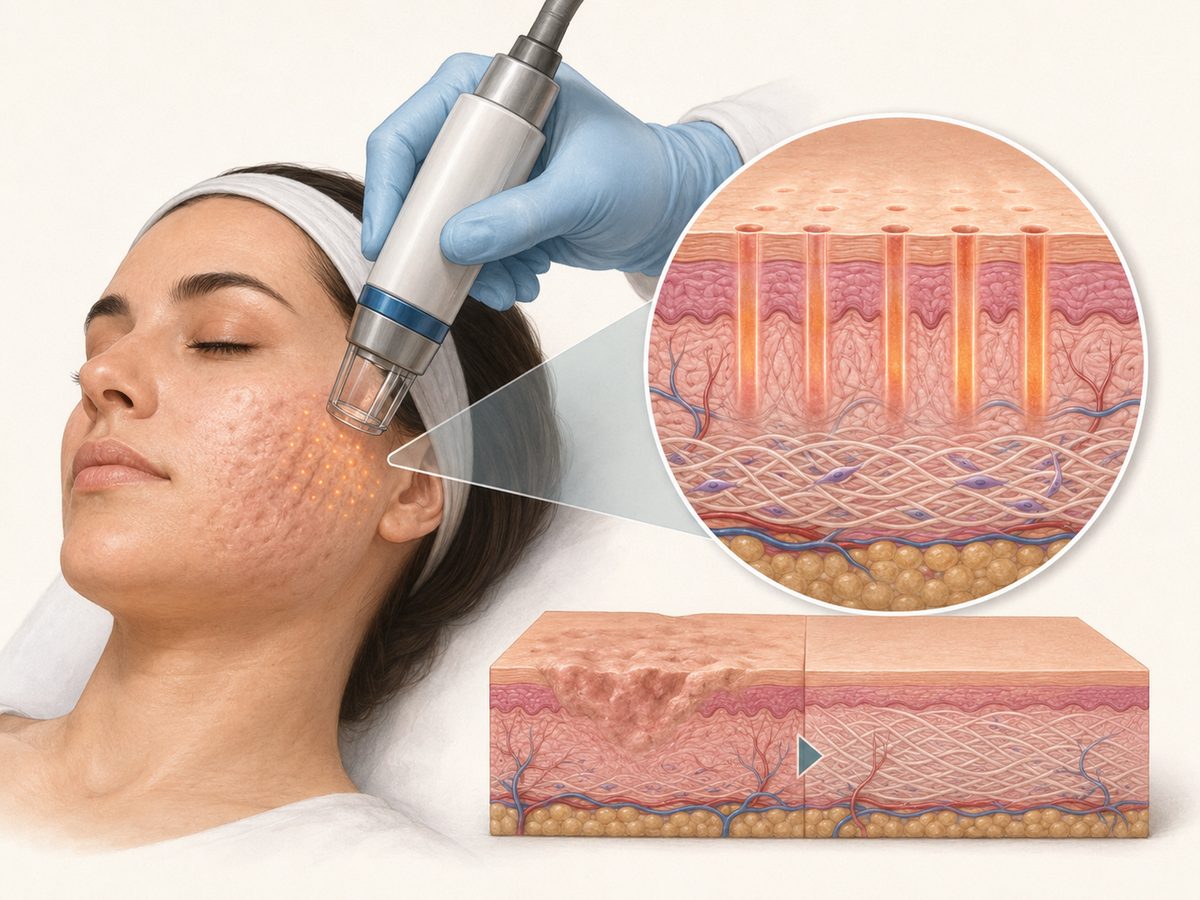
Lasers work by selective photothermolysis. A wavelength is chosen so that one target in the skin absorbs it: hemoglobin in blood vessels at 585 to 595 nm, water at 2,940 nm or 10,600 nm, deeper tissue at 1,064 nm. The absorbed light becomes heat, damaging the intended target and largely sparing the rest. Vascular lasers collapse the vessels feeding a red raised scar, starving the overactive fibroblasts. Ablative and fractional lasers create microscopic columns of controlled injury that restart the healing cascade. Enzymes break down stiff, disorganized collagen first, then fibroblasts lay down newer, better-aligned collagen over the following months.
What to expect
Most protocols run 3 to 6 sessions spaced 4 to 8 weeks apart. Numbing cream goes on 30 to 60 minutes beforehand, and deeper ablative work may need injected local anesthetic, a nerve block or light sedation. Patients commonly describe the sensation as a rubber band snapping against the skin. Afterward it stings and feels like bad sunburn for several hours. Non-ablative downtime is 1 to 3 days. Ablative CO2 means 7 to 14 days of swelling, peeling and crusting, then pink skin for weeks. Daily SPF 30 or higher is required for at least 3 to 6 months. Results keep improving for 6 to 12 months.
Risks and downsides
Review before treatment
- Post-inflammatory hyperpigmentation is the main risk. Transient darkening occurs in roughly 45.5% of Fitzpatrick III to V patients, and around 90% of those cases resolve within three months.
- Hypopigmentation, where pigment cells are damaged and pale patches are left behind, can be permanent.
- Prolonged redness lasting weeks to months, milia, and infection if aftercare is skipped.
- Blistering and purpura, particularly with pulsed dye and particularly in darker skin tones.
- Not appropriate over tanned skin, active infection or cold sores, within 6 to 12 months of oral retinoid use, or during pregnancy and breastfeeding.
- A test patch is the standard first step before treating any device-sensitive area, particularly in darker skin.
Compared with the alternatives
vs. Topicals
Silicone manages the environment a healing scar matures in and costs very little. Laser remodels the dermis, and only laser can lift a pit or free a stiff burn scar.
vs. Microneedling
Microneedling improves mild atrophic scars with lower pigmentation risk and 1 to 3 days of downtime, which matters in darker skin. Fractional CO2 goes deeper and does more, at the cost of recovery time.
vs. Steroid injections
For keloids, injection is first line and laser is an addition. Pulsed dye plus corticosteroid is a common pairing, since laser alone rarely stops a keloid from returning.
Common questions
Most protocols use 3 to 6 sessions spaced 4 to 8 weeks apart. Hypertrophic scars may need only 1 to 3 pulsed dye sessions. Burn scars can require ongoing treatment over months or years to maintain mobility.
Yes, with the right device and a clinician who treats skin of color regularly. Longer wavelengths such as 1,064 nm Nd:YAG and non-ablative fractional lasers are the safer starting points, together with test spots, conservative settings and strict sun avoidance before and after.
Usually not. Laser scar treatment is generally classified as elective and cosmetic. Documented functional impairment, such as a scar restricting joint movement, or significant chronic pain, are the exceptions worth putting in writing.
Clinical trials treat 50% to 75% improvement in texture, height and color as a strong outcome. The deep structure of the scar remains. The objective is a scar that no longer draws the eye or limits movement.