Subcision for scars
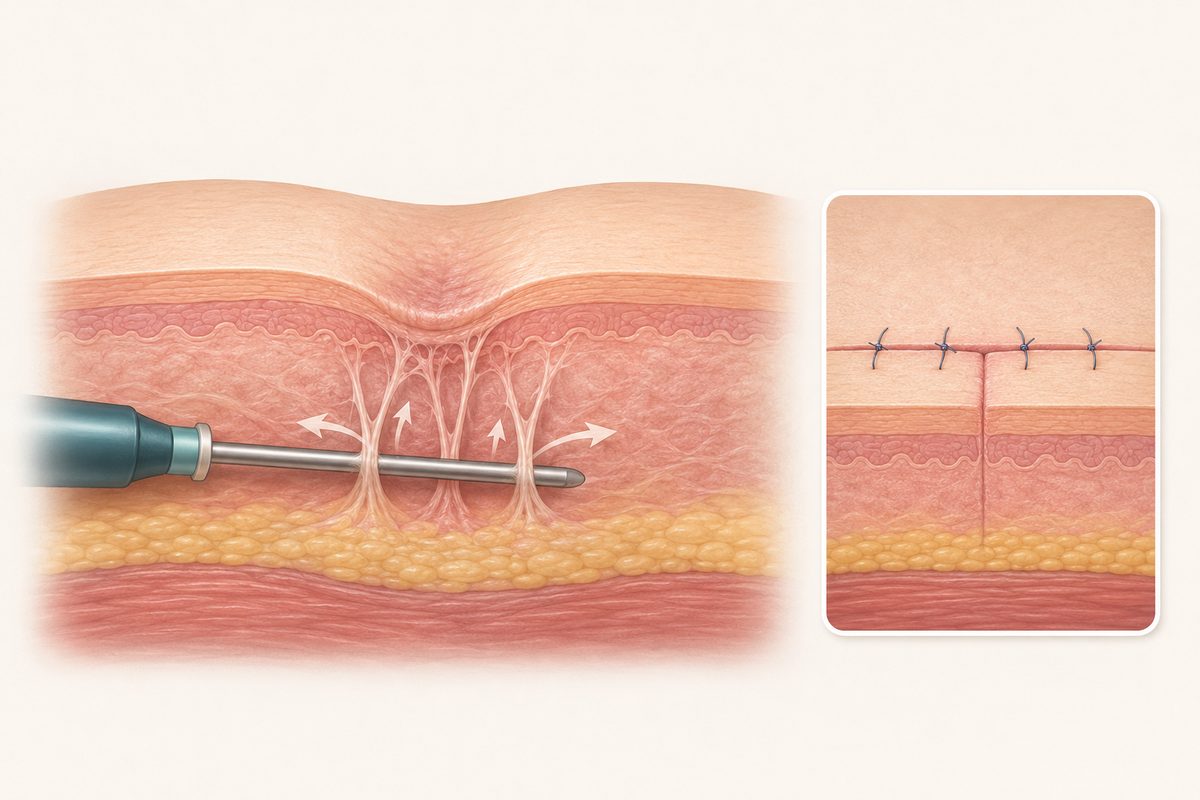
Subcision cuts the fibrous band tethering a depressed scar from underneath. It is the treatment for rolling scars and does nothing for ice pick scars.
Does it work?
Subcision treats a mechanical problem. A rolling scar is not missing much tissue at the surface; it is being pulled down from below by a fibrous band, and cutting that band lets the skin lift. That makes it the targeted option for rolling and tethered scars, and close to useless on ice pick scars, where there is no band to release. Our sources put improvement at 10% to 50% from a single session and 40% to 60% after two or three, figures that do not quite reconcile. Blunt cannula and sharp Nokor needle produce comparable results at six months, with the cannula bruising less. It is contraindicated on keloid-prone skin.
- Best for
- Rolling and tethered atrophic scars, including chickenpox pits that are anchored down. Not ice pick scars.
- Typical course
- 2 to 3 sessions for most people, up to 6 for severe scarring, spaced roughly 4 to 6 weeks. Collagen remodeling continues for 3 to 6 months, and up to a year in some reports.
- Evidence strength
- Moderate for rolling acne scars. Limited for chickenpox pits, where the position is extrapolated from acne scars rather than tested directly.
- Cost
- Our published corpus contains no cost or insurance information for subcision at all. We do not have a figure to give you.
Which scars it works on
| Scar type | Evidence | Expected result | |
|---|---|---|---|
| Acne scars (atrophic) | Moderate | The primary indication, specifically rolling scars. In one cannula subcision study the average number of scars per patient fell from 24.8 to 12.8 with 88% patient satisfaction. Our own two articles describe that same study as a landmark trial and as a small study of eight patients. | Hub → |
| C-section scars | Limited | Relevant to a tethered line, not an overhanging shelf. A shelf is a volume and fascia problem, and releasing a band will not lift it. | Hub → |
| Chickenpox scars | Limited | Used where a pox mark is tethered, not simply punched out. Subcision plus suction was tested against subcision plus sham pressure in a 2026 randomized split-face trial of 27 people with atrophic acne scars: no significant difference on objective measures, though physician and patient improvement scores favoured suction. That replaces an unattributed 71% improvement figure our corpus carried, and it makes the case for adding suction weaker rather than stronger. | Hub → |
| Hypertrophic scars | Not advised | Contraindicated. Subcision is a controlled injury under the skin, and in keloid-prone tissue that is a trigger, not a treatment. | Hub → |
| Keloid scars | Not advised | Contraindicated. Subcision is a controlled injury under the skin, and in keloid-prone tissue that is a trigger, not a treatment. | Hub → |
| Surgical and incision scars | Limited | Used for a depressed or tethered line where the skin is bound to the layer beneath. Our sources describe the technique but attach no outcome figures for surgical scars. | Hub → |
How it works
A rolling scar is held down by fibrous strands running from the underside of the skin to the deeper tissue. Subcision passes an instrument through a small entry point into the plane beneath the scar and severs those strands, which releases the skin and lets it sit level again. The controlled injury also creates a small pocket that fills with a blood clot and then with new collagen, and that new collagen holds the correction, so results keep improving for months after the appointment instead of appearing all at once. Instruments differ in how they cut. A Nokor needle has a tri-beveled scalpel-like tip that slices horizontally and handles dense focal bands well. A blunt cannula enters through a pilot puncture and undermines by pushing tissue apart, so it cannot easily cut a vessel or a nerve and instead moves them aside. Split-face studies in our sources found the two comparable at six months, with the cannula recovering faster.
What to expect
Local anesthetic, then a small entry puncture, not an incision, and the instrument is fanned under each scar. Swelling is immediate and peaks at 24 to 48 hours. Bruising is expected and one cited trial reported it in half of needle-based cases. Our sources disagree sharply about downtime: two say 1 to 2 days, while the article that compares instruments gives 3 to 7 days for the cannula and 7 to 14 for the sharp needle, and says most patients are comfortable socially by day 10. Plan for the longer end. You may see an early improvement that partly settles back as swelling resolves, then a real improvement from about 4 weeks as collagen forms, continuing for 3 to 6 months. Most people need 2 to 3 sessions. Subcision is often combined with filler to hold the released skin up, or with microneedling to remodel the surface above it.
Risks and downsides
Review before treatment
- Contraindicated if you are keloid-prone or have raised or keloidal scarring. Our sources are consistent on this.
- Bruising and swelling are expected effects, not complications, and are more pronounced with a sharp needle than a blunt cannula.
- Lumpiness or a firm nodule can form where the released space fills unevenly, more common with sharp instruments.
- Aggressive subcision, particularly with sharp blades, can rupture facial retaining ligaments and cause premature sagging. This appears in one of our articles and not in the flagship guide, so treat it as a real question to raise with an experienced operator.
- Our corpus lists no contraindication beyond keloid history: nothing on anticoagulants, isotretinoin, pregnancy, active infection or cold sores, for a procedure more invasive than the laser treatments that do carry full lists. Ask directly.
Compared with the alternatives
vs. Dermal fillers
Filler lifts a depression by adding volume. Subcision removes the thing pulling it down. If a scar is tethered, filler alone is fighting the band and the correction fades faster. The two are commonly used together in one appointment for that reason.
vs. Microneedling
Different depths. Microneedling remodels collagen in the dermis; subcision works in the plane beneath it and cuts structural bands a needle cannot reach. In a study of 45 patients the combination produced at least one grade of improvement in over 95% of participants.
vs. Fractional CO2 laser
Laser resurfaces from above and does not release a tether. For a rolling scar held down from below, laser improves texture while the depression remains. For boxcar scars with sharp walls, laser has more to work with.
Common questions
The usual test is whether the scar lifts when the skin around it is stretched. A depression that flattens out under tension is being tethered from below and is what subcision is for. One that does not change is more likely an ice pick or deep boxcar scar where tissue is missing, which needs a different approach. Two of our own articles describe this test in opposite terms, which we are correcting; the version consistent with the rest of the corpus is the one given here.
Two to three for most people, and up to six for severe or widespread rolling scars, spaced about 4 to 6 weeks apart. Improvement per session is reported at 10% to 50%, with 40% to 60% after two or three sessions. Those two figures do not reconcile cleanly.
No. An ice pick scar is a narrow deep tract where tissue is missing, not a tethered depression, so there is no band to release. TCA CROSS is the more suitable option, and punch excision for individual deep ones.
The released band does not reattach in the same way, and one of our sources describes results as generally settled by the six-month follow-up once new collagen has matured. New acne can create new scars, so treating active acne first matters.