Corticosteroid injections
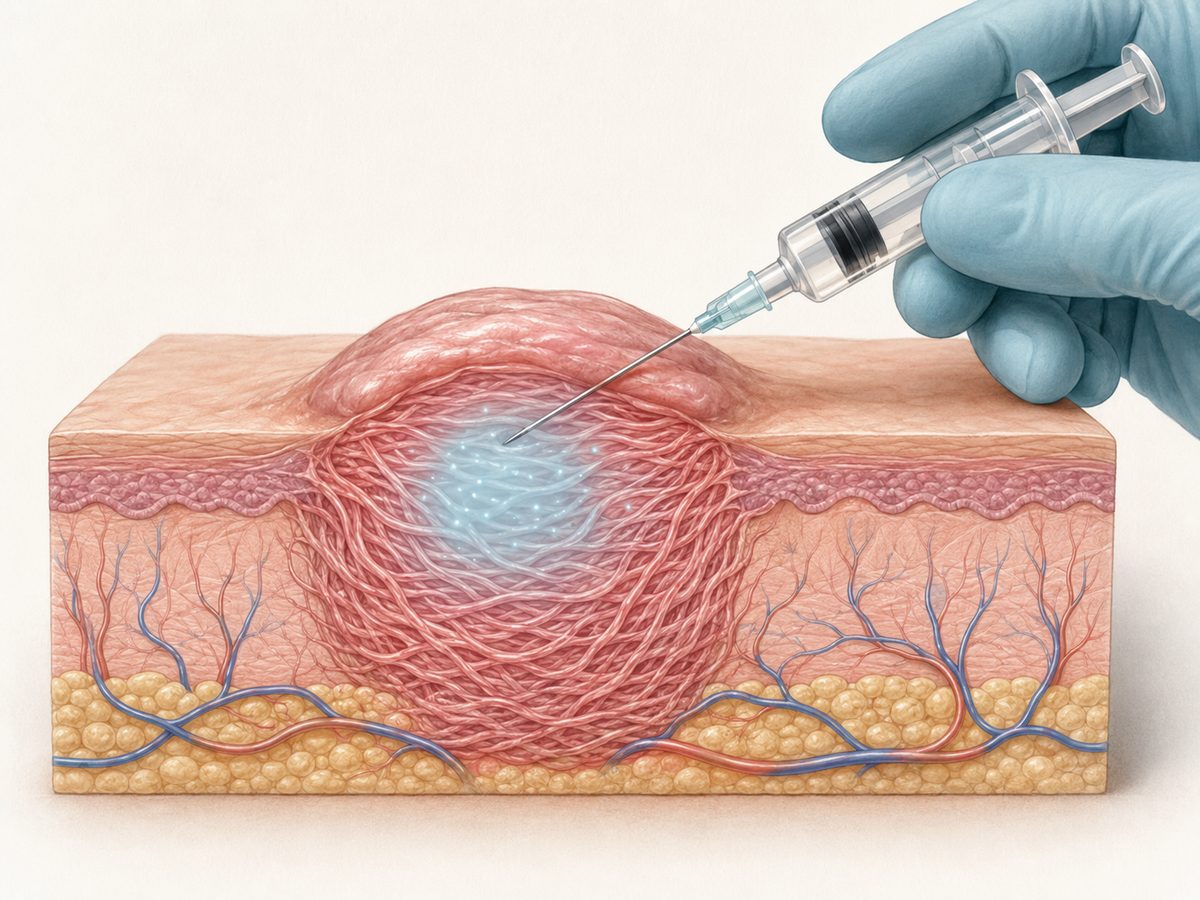
Injected steroid is first line for keloids and thick hypertrophic scars. It flattens and softens raised tissue, and recurrence is the limitation, not the flattening.
Does it work?
Intralesional triamcinolone is the most widely used treatment for raised scars and the one most condition guidance is built around. Reported flattening runs from 50% to 100% of treated scars, which is a wide range because studies score scars differently and treat different lesions. The honest limitation is not whether it flattens a scar but whether the scar stays flat: recurrence estimates run from 9% to 50% after steroid alone. That is why it is increasingly given in combination rather than by itself, and why surgery for a keloid is not done without an adjuvant.
- Best for
- Keloids and thick hypertrophic scars that are raised, firm and not settling on their own
- Typical agent
- Triamcinolone acetonide, injected into the scar rather than under it
- Course
- Repeated sessions several weeks apart, not a single treatment
- Main trade-off
- Local side effects in roughly 33% to 63% of patients, mostly skin thinning and pigment change
Which scars it works on
| Scar type | Evidence | Expected result | |
|---|---|---|---|
| C-section scars | Strong | Used where a cesarean scar has thickened or turned keloid rather than settling. Grade inherited: the trial evidence behind it is in hypertrophic scars and keloids, not c-section scars specifically. The mechanism carries over because it acts on excess collagen, but no c-section-specific trial supports this grade on its own. | Hub → |
| Hypertrophic scars | Strong | Flattening is reported in 50% to 100% of treated hypertrophic scars. Worth weighing against the fact that many hypertrophic scars flatten on their own over 12 to 18 months, so this is for scars that are thick or not settling. | Hub → |
| Keloid scars | Strong | First line. Flattening in 50% to 100% of cases, with recurrence from 9% to 50% after steroid alone, which is why it is often combined with 5-FU or used alongside excision rather than after it. | Hub → |
| Surgical and incision scars | Strong | For an incision that has thickened or raised. Given during or after keloid excision it addresses the 50% to 100% recurrence seen with surgery alone. Grade inherited: the trials behind it studied hypertrophic scars and keloids, which is what a raised surgical scar is, rather than surgical scars as a site. | Hub → |
How it works
A keloid or hypertrophic scar is collagen that kept being produced after the wound closed. Corticosteroid injected into that tissue suppresses the inflammatory signaling driving it, reduces collagen synthesis and increases its breakdown, so the scar softens and loses height. It acts on the excess tissue itself, which is why it does nothing for a depressed scar and nothing for tethering.
What to expect
The injection goes into the scar, which is firm, so it is more uncomfortable than a normal injection. Sessions are repeated several weeks apart and a course rather than one visit is normal. Expect the scar to soften and flatten gradually, and expect the itch and discomfort of an active keloid to settle earlier than its appearance does. Response varies with how long the scar has been there.
Risks and downsides
Review before treatment
- Skin thinning and depression at the injection site, and visible small vessels. These are the common local effects and are reported in roughly 33% to 63% of patients.
- Lightening of the skin around the injection, which is more visible and more persistent in darker skin tones.
- Pain during injection, because the tissue is dense.
- Whole-body effects are uncommon but possible with high or repeated doses, which is why dose and interval are controlled.
- Where atrophy or depression does develop, saline infiltration has been described as a corrective option. Discuss it rather than waiting to see.
Compared with the alternatives
vs. Silicone gel or sheets
Different jobs. Silicone is non-invasive, needs months of daily use and is first line for a raised scar you are managing at home. Steroid injection is a clinical procedure for a scar that is thick or not responding. They are combined more often than they are chosen between.
vs. 5-FU combination
Adding 5-FU to steroid outperforms steroid alone on standard scar scores in trials. One analysis reported 92% scar size reduction with excision plus serial 5-FU and triamcinolone against 73% with the comparator.
vs. Surgery alone
Excising a keloid without an adjuvant carries a 50% to 100% recurrence rate, often producing a larger scar than the original. Steroid is one of the adjuvants used to prevent that, which is why excision alone is not offered for keloids.
Common questions
More than a routine injection, because the scar tissue is dense and the fluid has to be forced into it. It is brief. Clinicians reduce it with fine needles, cooling or a local anesthetic mix.
A course, not one visit, spaced several weeks apart. How many depends on the scar's thickness and how it responds, and the interval matters because it limits total dose.
It can. Recurrence after steroid alone is reported between 9% and 50%. That is the main reason combination treatment and long follow-up are standard rather than optional.
Yes, and that is the trade-off to understand up front. Skin thinning, depressions and lightening at the injection site occur in a substantial minority. Both are more visible in darker skin.