Dermal fillers for scars
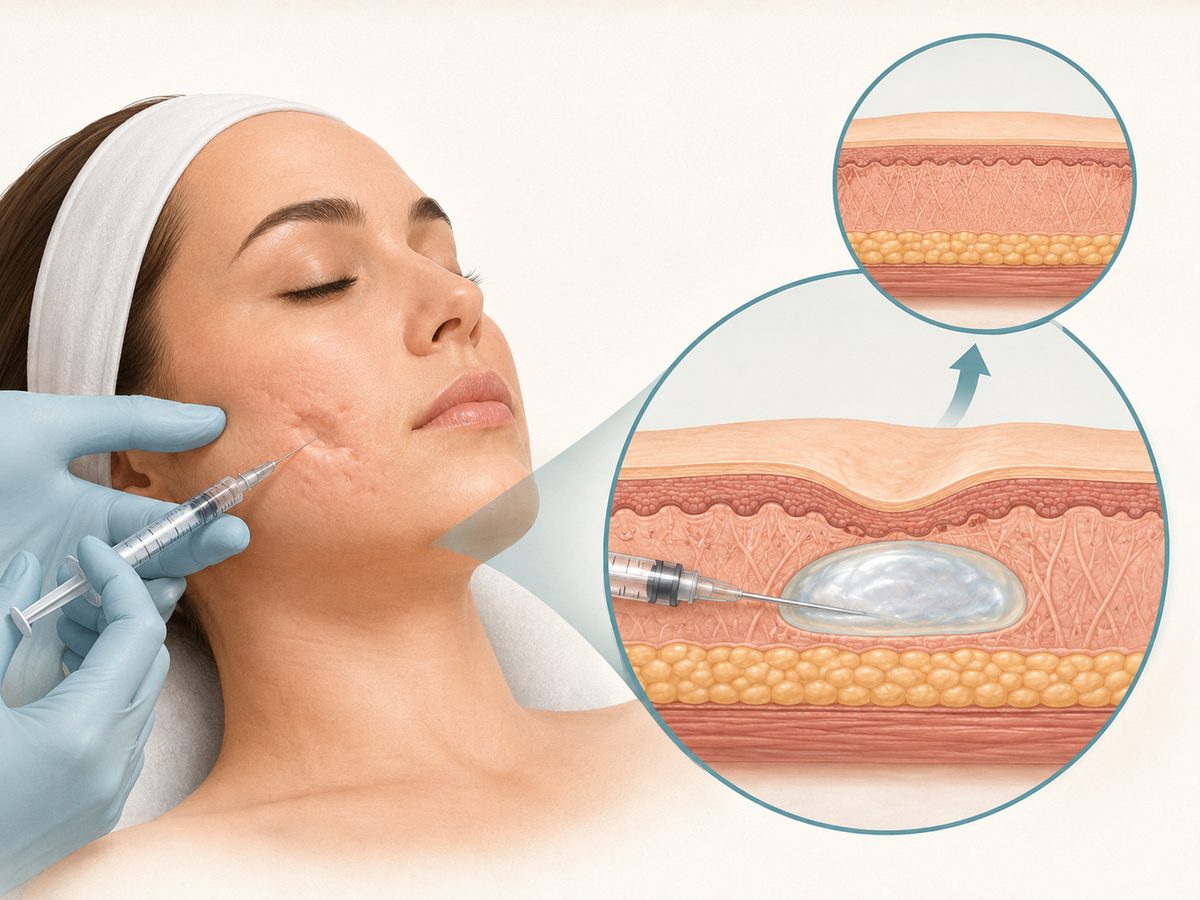
Fillers lift a depressed scar by adding volume under it. The correction is real and temporary, and it needs repeating.
Does it work?
A filler treats an atrophic scar as what it is: a hole. Injected underneath, it raises the floor of the depression toward the surrounding skin, and unlike resurfacing it works immediately. That makes it useful for rolling and shallow boxcar scars, and for individual deep scars that other treatments cannot lift. What it does not do is change the scar tissue. When the material breaks down the depression returns, on a timetable set by which material was used. Only PMMA is described in our sources as FDA-approved specifically for atrophic acne scars, in a double-blind multicenter trial where 64% of treated patients improved by 50% or more against 33% in the control group. Our own articles argue in several places that the improvement outlasts the material through stimulated collagen; the only one that names the evidence level for that says murine models, so we treat it as a proposed mechanism, not a result.
- Best for
- Rolling and shallow boxcar scars, and individual deep depressions. Frequently combined with subcision in the same appointment.
- Typical duration
- Hyaluronic acid roughly 6 to 12 months in our sources, with one trial documenting sustained improvement at 2 years. Calcium hydroxylapatite 12 to 18 months. PMMA is described as long-lasting to permanent.
- Evidence strength
- Moderate for atrophic acne scars, on one double-blind trial for PMMA. Our own filler article states in its conclusion that long-term head-to-head trials in scar tissue do not exist.
- Cost
- Our sources give roughly $500 to $2,000 per session, and a second article gives a wider $600 to $2,914 for dermal fillers across all uses. Neither breaks the figure down by material, which matters when hyaluronic acid lasts about a year and PMMA is designed not to resorb.
Which scars it works on
| Scar type | Evidence | Expected result | |
|---|---|---|---|
| Acne scars (atrophic) | Moderate | The main indication. Best on rolling and shallow boxcar scars where there is a floor to lift. In the PMMA trial, 64% of treated patients showed 50% or greater improvement at six months against 33% of controls. | Hub → |
| C-section scars | Limited | Hyaluronic acid is described as a way to lift a depressed segment of the line. It does not correct an overhanging shelf, which is a fascia and volume problem needing surgery. | Hub → |
| Chickenpox scars | Limited | Used for individual punched-out pits, usually alongside subcision if the mark is tethered. Our sources describe the approach without attaching controlled figures for chickenpox specifically. | Hub → |
| Hypertrophic scars | Not advised | Not indicated. These scars have too much tissue, not too little, and injecting more volume into them is the opposite of the treatment. | Hub → |
| Keloid scars | Not advised | Not indicated. These scars have too much tissue, not too little, and injecting more volume into them is the opposite of the treatment. | Hub → |
| Surgical and incision scars | Limited | Applicable to a depressed or tethered line, generally after subcision has released it. Not relevant to a raised or widened scar. | Hub → |
How it works
There are two mechanisms and they are not equally supported. The first is mechanical and immediate: the material occupies space beneath the depression and pushes the surface up. That is what you see at the appointment, and it lasts as long as the material does. Hyaluronic acid is a gel that the body gradually breaks down. Calcium hydroxylapatite is a microsphere suspension. PMMA is a suspension of non-absorbable microspheres in bovine collagen, so the carrier resorbs and the microspheres remain. The second proposed mechanism is biostimulation: stretching fibroblasts around the implanted material is said to prompt them to lay down their own collagen, which would mean part of the correction persists after the filler has gone. Four of our articles make some version of this argument and two of them use the word permanent for the resulting collagen. None carries a citation, and the one article that names an evidence level for it says murine models. We describe it here because it is the reason clinicians offer fillers for scars, and we do not present it as established.
What to expect
Treatment is a series of small injections under each scar, usually with topical anesthetic and often with lidocaine already in the product. The lift is visible immediately, then partly obscured by swelling for a few days. Redness, mild swelling and bruising at the injection sites are expected effects, not complications, and ice with gentle pressure straight afterwards reduces bruising. If subcision is done in the same appointment, expect bruising and swelling for 3 to 7 days, not a couple of days. Then the question is maintenance. Hyaluronic acid corrections are typically repeated at roughly 6 to 12 months, calcium hydroxylapatite at 12 to 18. PMMA is intended to last for years, which is also why it demands a more experienced injector: a poorly placed permanent material is far harder to fix than one the body will absorb.
Risks and downsides
Review before treatment
- Nodules and granulomas are the main concern, and our sources describe them as more common with permanent and semi-permanent materials. An inflammatory granuloma is a delayed immune response and may need steroid injection or surgical removal.
- Vascular occlusion is the rare serious risk of any filler injection: material enters or compresses a blood vessel and cuts off the blood supply. The FDA lists the consequences as tissue death, vision abnormalities including blindness, and stroke. It is rare, and it is why injector experience matters more here than in most cosmetic procedures. Seek medical attention immediately, during or shortly after treatment, if you have unusual pain, any change in vision, or skin near the injection site turning white, grey or blue.
- Material placed too superficially can show as a visible lump or a bluish tint, and in permanent fillers that is difficult to reverse.
- Hyaluronic acid can be dissolved with hyaluronidase if something goes wrong. PMMA and other permanent materials cannot, which is the strongest argument for starting with a reversible product.
- Not indicated on raised scars, and not a first choice on keloid-prone skin, where any injection is an injury.
Compared with the alternatives
vs. Subcision
Complementary, not competing. Subcision cuts the band holding a rolling scar down; filler holds the released skin up while new collagen forms. Filler alone on a tethered scar is working against the tether, and the correction fades faster.
vs. Fractional CO2 laser
Laser remodels scar tissue and gives a gradual, longer-lasting change in texture. Filler gives an immediate change in contour that wears off. For a face with mixed scarring, laser is usually the base treatment and filler handles individual depressions it cannot lift.
vs. Fat transfer
Autologous fat is the patient's own tissue and can treat much larger volumes. Our sources describe the surviving portion as long-lasting but give conflicting accounts of how much survives, with one saying a significant share may be reabsorbed within three months.
Common questions
It depends on the material. Hyaluronic acid is given as roughly 6 to 12 months in our sources, with one prospective trial documenting sustained improvement at two years. Calcium hydroxylapatite is given as 12 to 18 months. PMMA is designed not to resorb. Treat these as planning figures, not guarantees.
Possibly in part, and the evidence is thin. Several of our articles argue that stretching fibroblasts around the material prompts them to build collagen that remains. The one article that states the evidence level for that mechanism says murine models. Plan for the correction to need repeating.
PMMA is the only filler material our sources describe as FDA-approved specifically for atrophic acne scars. Others are used for scars off-label, which is ordinary in dermatology but useful context when comparing quotes.
Poorly, on their own. An ice pick scar is a narrow deep tract, not a broad depression, so there is little floor to lift. TCA CROSS or punch excision are the more suitable options, and filler is better aimed at the rolling and boxcar scars around them.