Microneedling for scars
Microneedling is first line for pitted acne and chickenpox scars, and it is contraindicated if you are keloid-prone. Expect 3 to 6 sessions and a partial result.
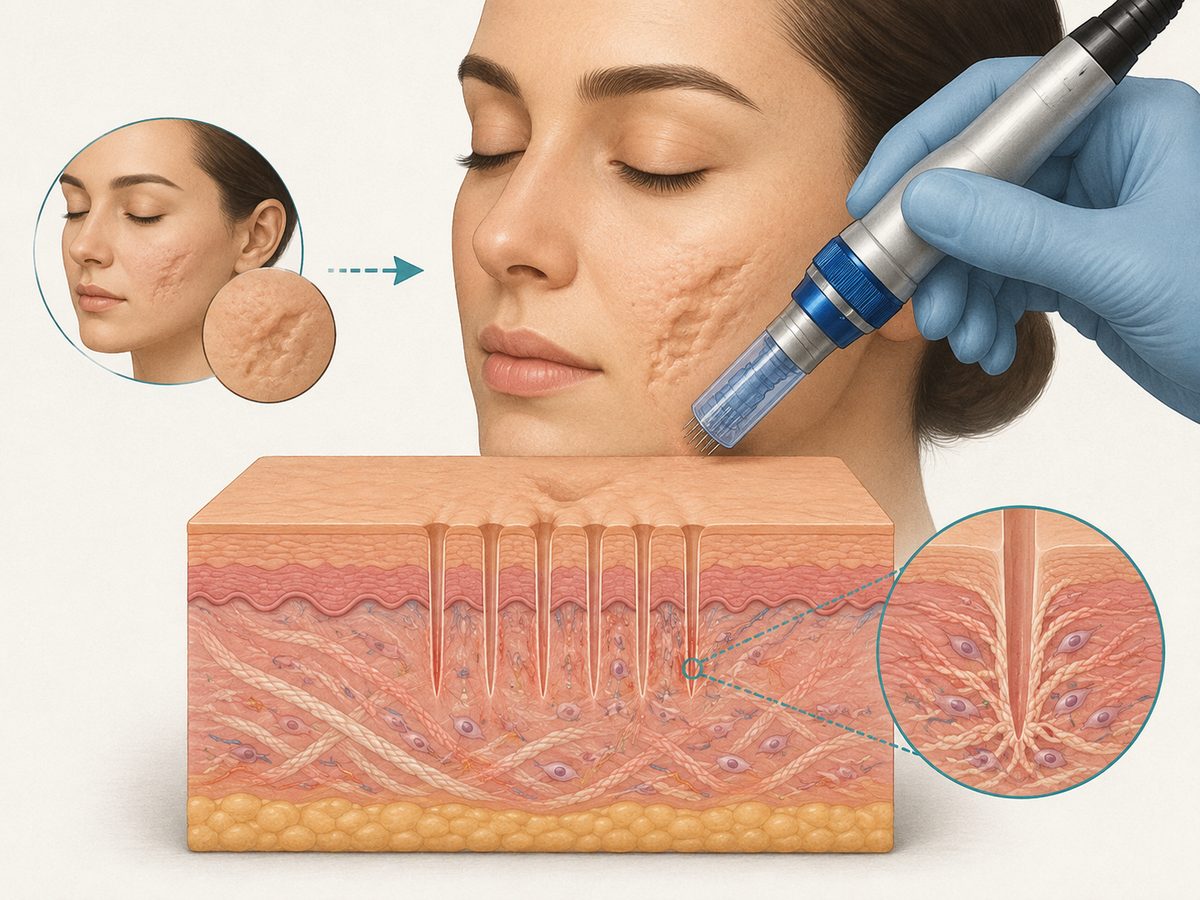
Does it work?
Microneedling has the strongest evidence of any non-ablative option for pitted acne scars, and it carries a lower pigmentation risk than laser, which matters in darker skin. A comparative study put microneedling alone at 39.71% mean improvement in atrophic scars, rising to 70.43% when combined with PRP or PRF. Several of our articles quote a higher 50% to 70% range with no study attached, and we do not use it. Rolling scars respond best, shallow boxcar scars respond well, and ice pick scars respond least. Standard microneedling is contraindicated on keloid-prone skin, where the same controlled injury can trigger new keloid growth.
- Best for
- Pitted acne and chickenpox scars, and surgical scars treated early. Not for keloids.
- Typical course
- 3 to 6 sessions. Our sources disagree on spacing: three articles say 2 to 4 weeks and several others say 4 to 6. Collagen keeps remodeling for 3 to 6 months after the last session.
- Evidence strength
- Moderate for atrophic acne scars. Moderate for early surgical scars and stretch marks. Limited for burn, C-section, chickenpox and hypertrophic scars. Contraindicated for keloids.
- Cost
- Our published articles give no dollar figures for microneedling anywhere. They note only that it is usually cheaper than ablative laser and is rarely covered by insurance.
Which scars it works on
| Scar type | Evidence | Expected result | |
|---|---|---|---|
| Acne scars (atrophic) | Moderate | The primary indication. Rolling scars respond best, shallow boxcar scars well, ice pick scars least, because a needle does not reach the base of a narrow tract. In one study of 31 patients the mean Goodman and Baron grade fell from 3.29 to 1.77 after three months. | Hub → |
| Burn scars | Limited | One prospective study of 15 patients with post-burn hypertrophic scars reported Vancouver Scar Scale scores falling from 8.8 to 4.1. Scars under a year old responded better. | Hub → |
| C-section scars | Limited | Described as improving texture and releasing a tethered line, better when combined with fractional radiofrequency. No controlled figures in our sources. | Hub → |
| Chickenpox scars | Limited | Same mechanism as atrophic acne scarring, and decades-old scars still respond. The direct evidence in our sources is one report in Dermatologic Surgery, not a trial. | Hub → |
| Hypertrophic scars | Limited | Graded Limited from 28 Sep 2026, replacing 'Not advised'. That was an over-extension of the keloid contraindication: hypertrophic scars stay inside the wound and do not behave like keloids. A systematic review of 58 studies in 1,845 patients covering hypertrophic and keloid scars reported improvement with no serious adverse events, a 2023 systematic review found needling and ablative fractional laser comparable and both tolerable and safe in atrophic and hypertrophic scars, and a 2024 prospective study of 15 post-burn hypertrophic scars moved Vancouver Scar Scale scores from 8.8 to 4.1, best in scars under a year old. No peer-reviewed source we could find reports microneedling worsening a hypertrophic scar. Limited rather than Moderate because the primary studies under those reviews are small and mixed and none is placebo-controlled. Needs careful patient selection, and anyone keloid-prone is excluded regardless of scar type. | Hub → |
| Keloid scars | Not advised | Contraindicated. Keloids extend beyond the wound and are driven by overactive fibroblasts and TGF-beta signalling, so the controlled injury that helps a pitted scar can trigger further growth. A history of keloids is treated as a contraindication to elective procedures that break the skin barrier. This is unchanged by the 28 Sep 2026 regrade of the hypertrophic row: the two are different scars and only hypertrophic moved. | Hub → |
| Stretch marks | Moderate | A 2024 systematic review and meta-analysis of 11 studies, six randomized, found improvement in stretch marks and better results than non-laser treatments, with higher patient satisfaction than laser. Expect modest change. Treatment is more painful than laser. | Hub → |
| Surgical and incision scars | Moderate | Timing decides the result. In a study of 25 women, starting at 6 to 7 weeks after surgery moved POSAS scores from 16.8 to 8.1, against 26.1 to 14.2 for those starting at 13 to 16 weeks. | Hub → |
How it works
Microneedling is percutaneous collagen induction. Fine needles make thousands of microscopic channels into the dermis while leaving most of the epidermis intact, which is the difference from ablative laser and from dermabrasion. Mechanically, the needles break apart the dense parallel collagen bundles and the fibrous tethers that hold a rolling scar down. Biologically, the injury restarts the healing cascade, and fibroblasts lay down new collagen in a more normal arrangement. The histology is the strongest evidence in our sources: three months after treatment, epidermal thickness rose from 63 micrometers to over 80, and type I collagen increased by about 16.5%. Types III and VII also rose. Clinicians treat uniform pinpoint bleeding as the sign the needles reached the dermis. Effects on TGF-beta signaling are widely described in our articles but hedged in the same sentences, and we treat them as proposed, not established.
What to expect
Numbing cream goes on 30 to 60 minutes beforehand. Professional devices use needle depths of about 1.5 to 2.0 mm for atrophic scars and 2.0 to 3.0 mm for thick scar tissue on the back or limbs. At-home rollers are limited to 0.25 or 0.5 mm, which does not reach the dermis where scar collagen is remodeled, so they change surface appearance at most. The session itself is brief. Afterward the skin is red and feels like sunburn, with 24 to 72 hours of visible redness in most sources. Sun protection is required, and active ingredients such as retinoids and vitamin C are held for 3 to 5 days. Some texture change appears within weeks, but new collagen keeps forming for 3 to 6 months after the final session, so the result at the last appointment is not the final result.
Risks and downsides
Review before treatment
- Contraindicated if you have, or have ever had, a keloid. The American Academy of Dermatology advises against it on that basis, and a keloid history anywhere on the body counts, not only at the treatment site.
- Not over active acne, active infection or a herpes simplex outbreak, since the needles can spread bacteria. Our sources list herpes as a contraindication but never mention antiviral prophylaxis, which is a gap worth raising with your clinician.
- Post-inflammatory hyperpigmentation is uncommon and not impossible. It is lower than with laser because no heat is used and melanocytes are not targeted, and it usually resolves.
- Recent isotretinoin is a contraindication. Our sources give four different windows, from one month to twelve, so this is a question for your prescriber. Do not take a number for it off a web page.
- At-home dermarollers dull and hook with reuse, which tears skin instead of puncturing it, and reused needles carry an infection risk that a clinic setting does not.
Compared with the alternatives
vs. Fractional CO2 laser
Laser goes deeper and does more in fewer sessions, at the cost of 5 to 10 days of downtime against 1 to 3, and a materially higher pigmentation risk. In a trial in darker skin types, microneedling improved scars by two points or more in 73% of patients against 33% for a 35% glycolic acid peel, and the same low-pigment-risk logic is why it is often chosen over ablative laser in Fitzpatrick IV to VI.
vs. Subcision
Different targets. Subcision cuts the fibrous band tethering a rolling scar from below; microneedling remodels the collagen above it. They are frequently combined, and in a study of 45 patients the combination produced at least one grade of improvement in over 95% of participants.
vs. Silicone and topicals
Not comparable. Silicone manages the environment a raised scar matures in and does nothing for a pit, since a pit is missing tissue. Microneedling is one of the few options that adds collagen back.
Common questions
Least of the three atrophic types. An ice pick scar is a narrow V-shaped tract running deeper than a needle reaches, so the response is more moderate than for rolling or boxcar scars. TCA CROSS is the more targeted option for those, and the two are often used on the same face.
Yes, and it is one of the safer resurfacing choices in Fitzpatrick IV to VI. It uses no heat and does not target melanin, so the pigmentation risk that governs laser choice is much lower. Research in Vietnamese and Indian populations found it safe and effective, and one of those found no long-term hyperpigmentation. Sun protection afterwards still matters.
Not for scars. Home devices are limited to 0.25 or 0.5 mm and do not reach the dermal layer where scar collagen is remodeled. They may improve product absorption and surface appearance. Reused rollers also dull, and a dull needle tears skin instead of puncturing it.
Not standard microneedling. Our sources describe one carve-out, microneedle electroporation combined with intralesional corticosteroid under medical supervision, and the supporting evidence is a single case report over 15 sessions and 8 months. Treat that as a specialist decision, not an option to seek out.