Scar creams and topical treatments
Medical-grade silicone is the only topical supported by multiple randomized trials. Retinoids are rated Moderate for dark marks and shallow texture. Vitamin E is rated Weak and irritates about one user in three. No cream fills a deep pit.
Does it work?
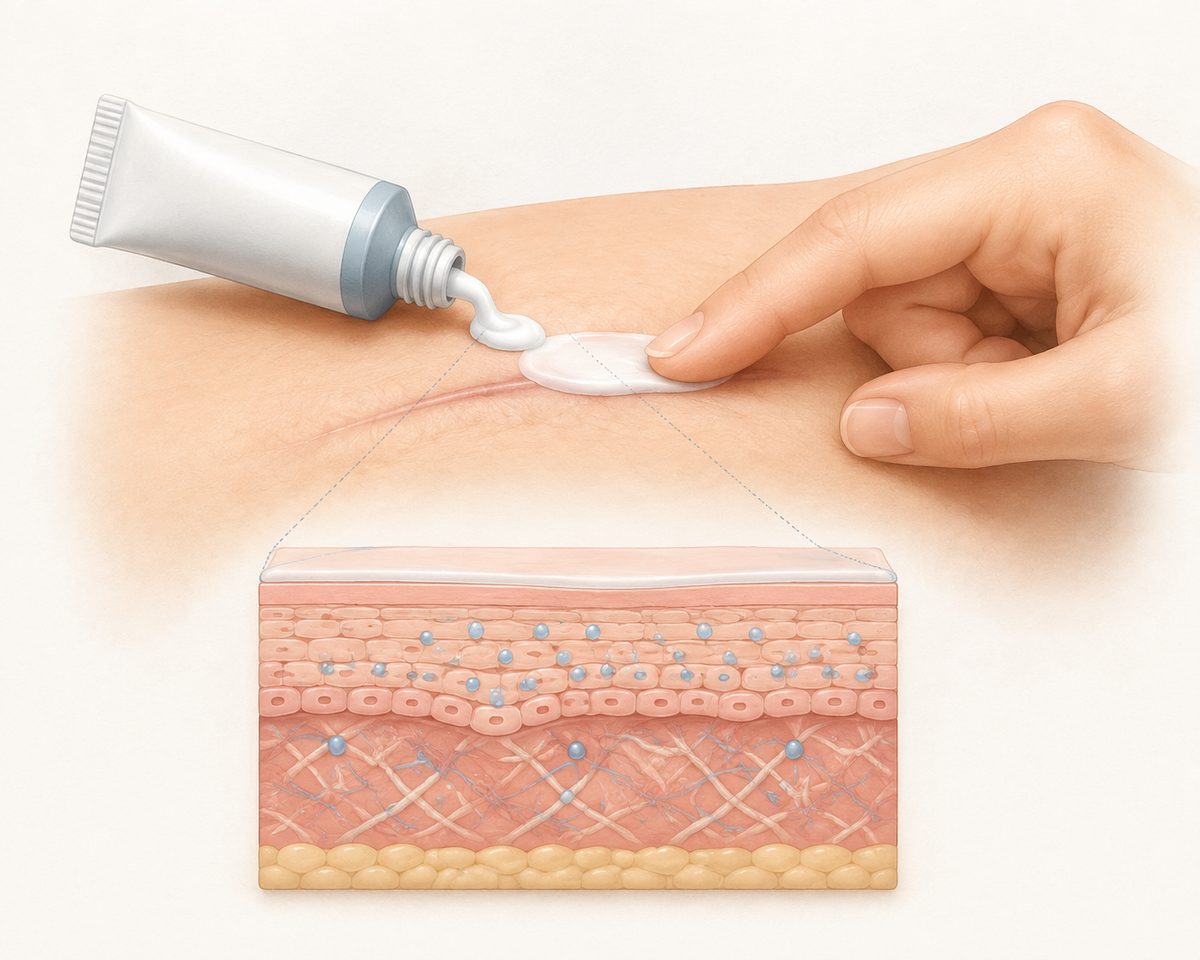
Topical treatment works within limits. Medical-grade silicone is the only topical category supported by multiple randomized trials, and it helps raised scars: hypertrophic, keloid-prone and fresh surgical lines. Retinoids have good evidence for dark marks and shallow acne texture. Onion extract and allantoin are moderate at best. Vitamin E is weak and irritates roughly one user in three. No cream fills a deep pit or removes a scar. Expect 2 to 6 months before anything is visible.
- Best for
- Raised and immature scars, dark marks, and stopping a fresh surgical line from thickening. Not deep pits.
- Typical course
- Twice daily on fully closed skin. 8 to 12 weeks minimum for new scars, 3 to 6 months for old ones.
- Evidence strength
- Strong for medical-grade silicone. Moderate for retinoids and allantoin. Moderate for onion extract. Weak for vitamin E.
- Cost
- Our price source groups topical treatments with chemical peels at roughly $100 to $519 per course. Over-the-counter silicone gels sit at the low end.
Which scars it works on
| Scar type | Evidence | Expected result | |
|---|---|---|---|
| Acne scars | Moderate | Retinoids fade dark marks and improve shallow texture. Deep ice pick and boxcar pits do not respond. | Hub → |
| Burn scars | Strong | First-line for raised burn scars, usually layered with pressure garments. | Hub → |
| C-section scars | Strong | Handles color and thickness along the line. A tethered shelf or overhang needs a procedure. | Hub → |
| Chickenpox scars | Limited | Retinoids help the leftover pigment. The punched-out pit itself needs TCA CROSS, needling or laser. | Hub → |
| Hypertrophic scars | Limited | Silicone flattens and softens raised tissue over months. True keloids also need injections, with the cream in a supporting role. | Hub → |
| Keloid scars | Limited | Silicone flattens and softens raised tissue over months. True keloids also need injections, with the cream in a supporting role. | Hub → |
| Surgical and incision scars | Strong | Silicone started once the incision is closed reduces height and redness. The evidence here is the strongest for any cream. | Hub → |
How it works
Most of the effect comes from occlusion, not absorption. New scar tissue has an immature outer layer and loses water through it faster than intact skin. Silicone sits on the surface as a thin film and cuts that water loss, and the resulting hydration appears to signal fibroblasts to slow collagen production. The film does the work, not any botanical added to it. Retinoids operate differently: they penetrate, bind retinoic acid receptors, speed cell turnover and push fibroblasts to build new collagen, which suits pits and pigment more than raised tissue. Azelaic acid, vitamin C and niacinamide target melanin production.
What to expect
Nothing goes on an open wound. Wait until the skin has fully closed, with no scabbing or oozing and stitches out, usually 10 to 14 days after surgery. Then apply a thin layer twice a day. Too much gel takes too long to dry, and a film that sets in 2 to 5 minutes is about right. Sheets need 12 to 24 hours of wear a day. Less itch and a softer feel usually come first, sometimes within 4 weeks. Height and color take 8 to 12 weeks, and old scars 3 to 6 months. There is no downtime. Consistency over months is the main difficulty.
Risks and downsides
Review before treatment
- Silicone is chemically inert and rarely allergenic, but contact dermatitis is reported in roughly 1 to 2% of gel users, and sheets add adhesive reactions, sweating and itching.
- Vitamin E oil caused contact dermatitis in about one user in three in the best-known trial, and had no effect or made the scar look worse in 90% of cases.
- Occlusive products over active acne or folliculitis can make the inflammation worse, particularly on oily skin.
- Retinoids sensitize skin to sunlight and are avoided in pregnancy and breastfeeding. Kojic acid and strong lightening agents irritate reactive skin.
- Skin that turns soggy and white under a sheet is over-hydrated. Remove the sheet for a few hours.
Compared with the alternatives
vs. Laser
Creams manage the surface environment. Laser remodels the dermis. For a deep pit or a stiff burn scar, no cream matches a fractional device. For a fresh incision, silicone is the better first move.
vs. Steroid injections
For an established keloid, injection is first line and the cream is supporting. Creams do not flatten dense keloid tissue on their own, but they hold ground between appointments.
vs. Natural remedies
The two sit on the same shelf with very different evidence behind them. Medical-grade silicone has multiple randomized trials. Aloe, honey and vitamin E rest on small studies, laboratory work or habit, and vitamin E carries a real irritation risk.
Common questions
No. Scar tissue is a permanent structural change. Creams flatten, soften and fade it, and a good result is a scar that stops catching the eye. Any product promising removal is overselling.
Once the wound is fully closed: no oozing, no scabs, stitches out. That is usually 10 to 14 days. Putting an occlusive product on earlier can trap moisture against tissue that is not ready.
For a mild-to-moderate hypertrophic scar, often yes, given 8 to 12 weeks of daily use. For a thick or spreading raised scar, creams are first line but not sufficient, and steroid injection or laser usually joins them.
Slower and less predictably, but yes. Silicone has improved pliability and texture in scars several years old, and one report describes changes in decades-old scars. Budget 3 to 6 months, not 8 weeks.