Silicone gel and silicone sheets
Silicone has more randomized-trial evidence behind it than any other scar topical. The benefit depends on daily use over months.
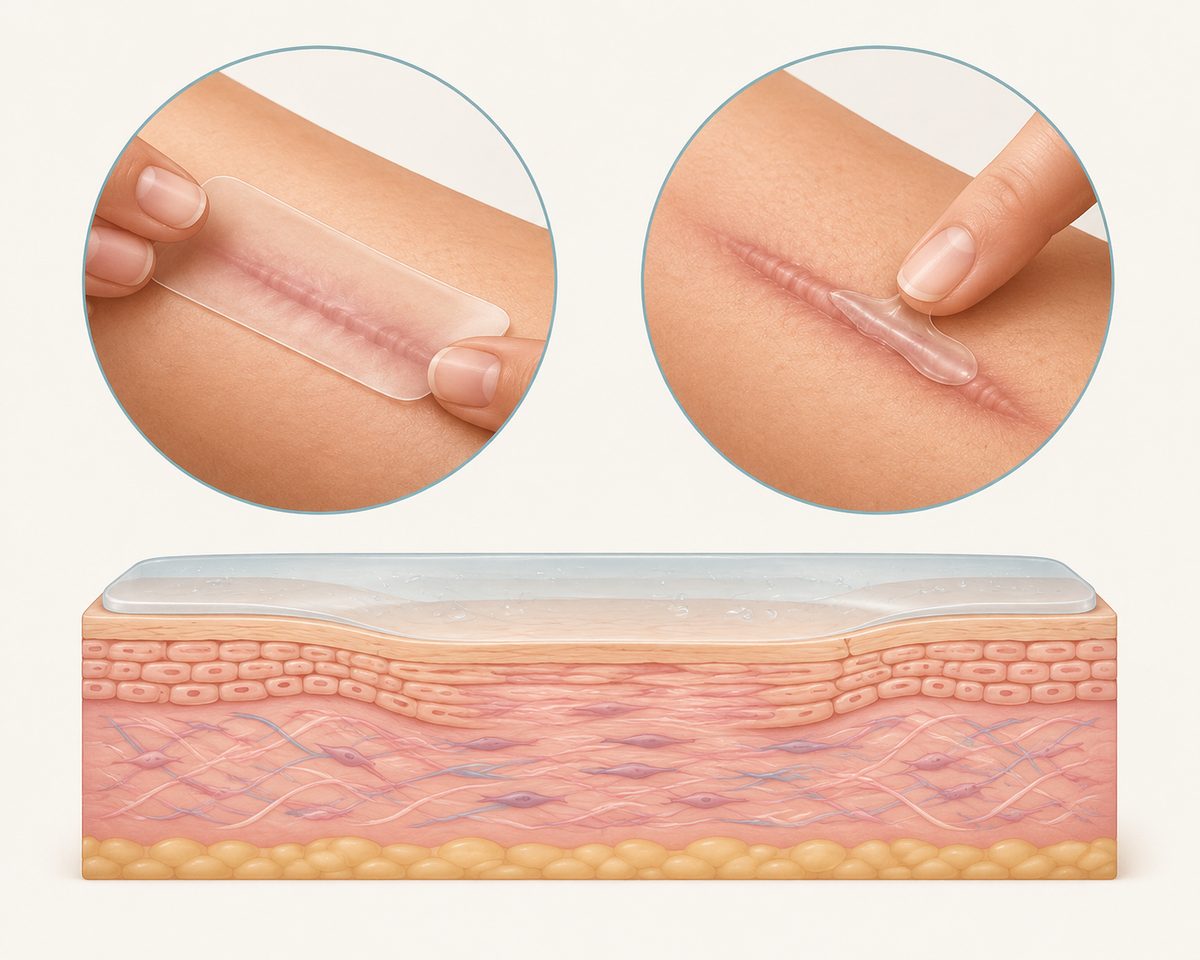
Does it work?
Silicone is a first-line non-invasive treatment for raised scars in scar-management guidelines, and the only topical category supported by multiple randomized trials. It reduces height, redness, stiffness and itch in hypertrophic scars, and helps stop a fresh surgical wound from thickening. Evidence is weaker for keloids and weaker still for pitted acne scars, which are a tissue deficit and not an excess. Reviews note that many of the studies are small and at risk of bias. The realistic outcome is a flatter, paler scar.
- Best for
- Raised, immature hypertrophic scars and fresh surgical incisions. Also used on keloids, alongside injections, not instead of them.
- Typical course
- 12 to 24 hours of contact a day. 8 to 12 weeks minimum, 60 to 90 days after surgery, up to 6 months if you are keloid-prone or the scar is large.
- Evidence strength
- Strong for post-surgical scars. Moderate for hypertrophic. Moderate for keloids. Limited for atrophic acne scars.
- Cost
- The cheapest treatment on this site with strong evidence behind it. Our sources give no dollar figures, but note that a 15 g tube covers a 3-inch scar twice daily for about 90 days.
Which scars it works on
| Scar type | Evidence | Expected result | |
|---|---|---|---|
| Acne scars | Limited | A pit is lost tissue, not excess collagen, and an occlusive film has little to act on. Raised acne scars on the chest or jaw are a different case. | Hub → |
| Burn scars | Strong | First-line for raised burn scars, normally layered with pressure garments. Gel over joints and face, sheets on flat areas. | Hub → |
| C-section scars | Strong | The main topical for a cesarean line, from about 10 to 14 days after surgery. It manages color and thickness, and will not lift a tethered shelf. | Hub → |
| Hypertrophic scars | Moderate | Occlusion and hydration on a raised scar that is still active. Support is stronger here than for keloids, where silicone is an adjunct rather than a mainstay. Graded Moderate from 17 Sep 2026, matching /scar-types/hypertrophic/: the Cochrane review specific to treating hypertrophic scars rates all its evidence low or very low certainty. Prevention on a fresh surgical wound is graded separately and is unchanged. | Hub → |
| Keloid scars | Moderate | Strong evidence is for hypertrophic scars, which stay inside the wound. For true keloids it is weaker: silicone supports steroid injection without replacing it, and it is unlikely to flatten a dense mature keloid on its own. | Hub → |
| Surgical and incision scars | Strong | Started once the incision is closed. A 2020 review of six studies found topical silicone significantly reduced both scar pigmentation and height after surgery. | Hub → |
How it works
New scar tissue has an immature stratum corneum and loses water through it faster than intact skin. That dryness appears to keep fibroblasts switched on, and collagen keeps accumulating. Silicone, as a self-drying gel or a sheet, forms a semi-occlusive film that cuts transepidermal water loss and rehydrates the surface. Well-hydrated surface cells appear to signal fibroblasts to slow down. The film also shields the scar from bacteria that would otherwise keep the immune response running. Effects on TGF-beta and related growth factor signaling are widely described but not fully established in humans. The mechanism is occlusion, not absorption.
What to expect
Nothing goes on until the wound has fully epithelialized: skin closed, no oozing or crusting, stitches out. After surgery that is usually 10 to 14 days. Wash with a mild fragrance-free soap, dry completely, then apply a very thin layer. Gel that takes longer than five minutes to set means too much was applied. Rub it in for a couple of minutes, then leave it. Sheets can be washed and reused for days. Aim for at least 12 hours of contact daily, ideally closer to 24. Itch and tightness often ease first. Height and color shift over 2 to 3 months, and mature scars over 6.
Risks and downsides
Review before treatment
- Never on an open or crusting wound. Occlusion over tissue that has not closed can trap moisture and contaminants against it.
- Contact dermatitis or irritant reaction occurs in roughly 1 to 2% of gel users. Sheets add adhesive reactions, sweating and itching, and peel off joints and oily skin.
- Maceration: skin under a sheet that turns soggy and white is over-hydrated and needs a few hours uncovered.
- Occluding active acne or folliculitis can make it worse, particularly on oily skin.
- Sheets need supervision in very young children, since they can detach and be swallowed. Silicone does not treat post-inflammatory hyperpigmentation. Daily sun protection does.
Compared with the alternatives
vs. Onion extract gels
Both sit on the same drugstore shelf, and only one has multiple randomized trials. A meta-analysis concluded onion extract gel is no better than other topical treatments. Silicone is the default choice.
vs. Steroid injections
Injections are first line for an established keloid and act faster on dense tissue. Silicone is the maintenance layer: cheap, painless and usable between appointments.
vs. Pressure garments
For large raised burn scars these are used together. Garments apply 15 to 30 mmHg across big areas, and silicone handles the surface and the awkward spots garments miss.
Common questions
Efficacy is comparable when both are used consistently. Sheets add mild pressure and suit flat areas under clothing. Gel stays put on the face and over joints and takes sunscreen or makeup on top once dry. Adherence decides which format is better for a given person.
Some softening at around 4 weeks. Meaningful change in height and redness usually needs 2 to 3 months, and mature scars up to 6. The benefit comes from continuous hydration, so skipping days undoes the cumulative effect.
Little. Silicone works by damping down excess collagen, and an atrophic scar is a shortage of tissue. Retinoids, microneedling and fractional laser address a pit.
Yes, and it is often preferred for children because it is inert, sits on top of the skin and does not hurt. A 2025 pediatric clinical practice guideline for children aged 1 to 14 names silicone-based agents as the strongly recommended first-line topical. Sheets need supervision in toddlers.