Chemical peels and TCA CROSS
Full-field peels do modest work on scar texture and pigment. TCA CROSS, applied only into the pit, is the strongest peel-based option for ice pick scars.
Does it work?
Two different procedures share the word peel. A full-field peel takes off a controlled depth of skin across an area and improves surface texture and pigment. TCA CROSS puts a high concentration of the same acid into the base of a single scar and leaves the skin around it untouched. That is how it reaches ice pick scars that nothing applied across the whole face can touch. The evidence favors CROSS: in a 100-patient study 41% had marked improvement of more than 75% and another 42% moderate improvement, after six sessions three weeks apart. Full-field peels have now been tested against their main rivals and come out level rather than behind. A 2026 meta-analysis of 11 head-to-head studies in 713 people found no significant difference between microneedling and chemical peels on clinically significant improvement, with microneedling ahead only on the weakest endpoint, any improvement at all. A 2026 meta-analysis of 38 studies and 1,695 patients comparing lasers with peels found no significant efficacy difference for acne or acne scarring. The single trial we previously leaned on, favouring microneedling 73% to 33% in darker skin, is one study inside that larger picture. Pigmentation risk governs everything here.
- Best for
- TCA CROSS for ice pick and narrow boxcar scars. Full-field peels for surface texture and post-inflammatory pigment, not for depth.
- Typical course
- Superficial peels: 3 to 6 sessions, 2 to 5 weeks apart. Medium peels repeat at 6 to 12 months. TCA CROSS: 4 to 6 sessions about 3 weeks apart.
- Evidence strength
- Moderate for TCA CROSS on ice pick scars. Moderate for full-field peels on scar texture, on two 2026 meta-analyses that find them level with microneedling and with laser on acne scarring rather than behind.
- Cost
- Our sources group topical treatments and chemical peels together at roughly $100 to $519 per course, which is a loose proxy and not a peel-specific price.
Which scars it works on
| Scar type | Evidence | Expected result | |
|---|---|---|---|
| Acne scars (atrophic) | Moderate | TCA CROSS is the targeted option for ice pick and narrow boxcar scars. In a 100-patient study, 41% had marked improvement of more than 75% and 42% moderate improvement after six sessions. Full-field peels do less for depth and more for the pigment around the scars. | Hub → |
| Chickenpox scars | Moderate | Same technique and the same logic as ice pick acne scars, since a pox mark is a punched-out pit. Reported alongside microneedling and fractional laser as one of the main options for pox marks. | Hub → |
| Hypertrophic scars | Not advised | Not a treatment for raised scars. A peel removes tissue from the surface and does nothing about excess collagen underneath, and the injury itself carries risk in keloid-prone skin. | Hub → |
| Keloid scars | Not advised | Not a treatment for raised scars. A peel removes tissue from the surface and does nothing about excess collagen underneath, and the injury itself carries risk in keloid-prone skin. | Hub → |
| Stretch marks | Limited | Glycolic acid or TCA resurfacing appears in our sources for striae with modest reported benefit. Nothing here removes a mature white stretch mark. | Hub → |
| Surgical and incision scars | Limited | Used for surface texture and discoloration along a healed line, not for a raised, widened or tethered scar. Our sources attach no controlled figures for surgical scars. | Hub → |
How it works
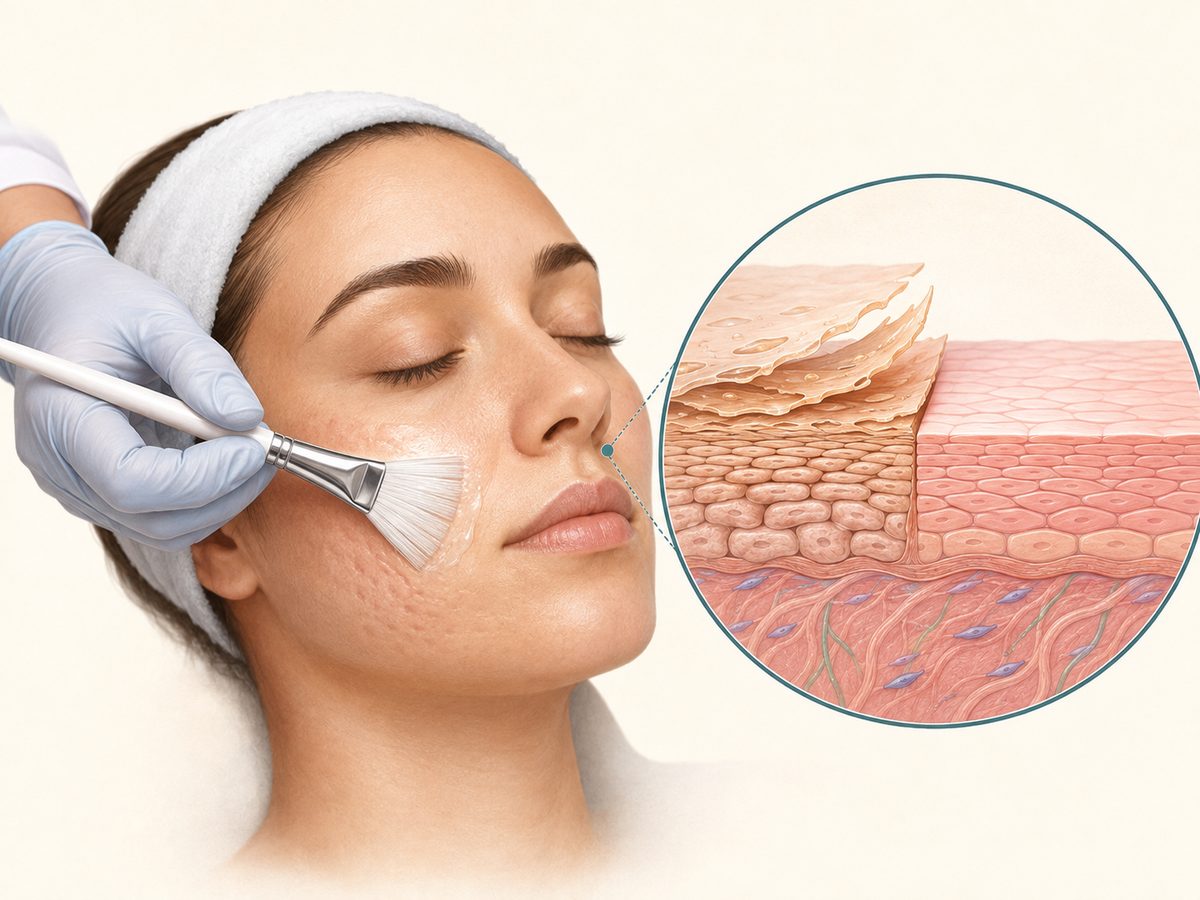
A chemical peel applies an acid that destroys tissue to a controlled depth, and the skin then rebuilds. Depth is what determines both effect and risk. Superficial peels, typically glycolic acid at 30% to 50%, reach the epidermis and improve tone and fine texture. Medium peels using TCA, or Jessner's solution followed by TCA, reach the papillary dermis and can improve shallow textural scarring. Deep peels use phenol and are largely reserved for lighter skin. Our sources disagree on the exact TCA concentration at which a peel becomes deep, one saying above 40% and another above 50%, and that threshold matters because depth drives pigmentation risk. TCA CROSS inverts the whole approach. Instead of treating an area, a very high concentration is placed into the base of one scar with a toothpick or fine applicator. The pit is destroyed and rebuilds from the bottom with new collagen, lifting the floor of the scar toward the surface, while the surrounding skin is never treated at all.
What to expect
For a full-field peel: the acid goes on for a defined time, the skin frosts or reddens, and it is neutralized or self-limits. Superficial peels give a few days of flaking. Medium peels give 7 to 14 days of visible peeling and redness. Sun protection is mandatory afterwards, and starting a pigment-suppressing regimen beforehand is standard in darker skin. Series of 3 to 6 superficial sessions are usual, spaced 2 to 5 weeks. For TCA CROSS: each scar is treated individually, which takes minutes, and a white frost appears in each pit immediately. A crust forms over each treated scar and falls off within about a week, and the improvement builds over months as collagen fills the base. Plan on 4 to 6 sessions roughly three weeks apart. Because only the pit is treated, downtime is far shorter than a full-field peel of equivalent strength.
Risks and downsides
Review before treatment
- Post-inflammatory hyperpigmentation is the governing risk, and in darker skin our sources describe the resulting dark patches as harder to treat than the original scar.
- Higher TCA concentrations buy more effect and more risk together. A 2026 review of 34 publications and 937 patients found complication rates rise with concentration, and that transient post-inflammatory pigment change is the commonest adverse event.
- The CROSS evidence base runs to Fitzpatrick V. That same 2026 review covered types I to V, so there is no trial evidence here for Fitzpatrick VI, which is the group the pigmentation risk matters most for. Ask what your practitioner is extrapolating from.
- Peels can cause scarring themselves if taken too deep or if aftercare is poor. One of our articles notes that at-home users often wait too long to seek help when something goes wrong.
- Phenol and other deep peels are described in our sources as appropriate for Fitzpatrick I to III only.
- TCA CROSS applied outside the pit will burn normal skin. This is a technique-dependent procedure and not something to attempt at home.
- Not over active infection, and not on skin recently treated with isotretinoin. Our sources are thinner on peel contraindications than on laser contraindications.
Compared with the alternatives
vs. Microneedling
The one head-to-head trial in our corpus favors microneedling: in Fitzpatrick IV to VI, 73% of microneedling patients improved by two points or more against 33% for a 35% glycolic peel. Microneedling also carries a lower pigmentation risk, which is the deciding factor for most people with darker skin.
vs. Fractional CO2 laser
Laser gives finer control over depth and treats fractionally, leaving untreated skin between columns to speed healing. A medium peel treats the whole surface at once. Laser generally outperforms peels on texture, at higher cost and more downtime.
vs. Subcision
Different problems. Subcision releases a tethered rolling scar from below; a peel or CROSS works on the surface and the pit. Ice pick scars go to CROSS, rolling scars go to subcision, and many faces need both.
Common questions
CROSS stands for chemical reconstruction of skin scars. A very high concentration of trichloroacetic acid, usually 70% to 100%, is placed only into the base of an individual scar, not across the skin. The pit rebuilds from the bottom with new collagen while the surrounding skin is untouched, and that is how it reaches ice pick scars that no full-field treatment can.
With care and the right agent. More active melanocytes mean a higher risk of post-inflammatory hyperpigmentation, and our sources describe the resulting marks as harder to treat than the scar you started with. Superficial agents such as mandelic and lactic acid are the conservative choices, deep phenol peels are described as suitable for Fitzpatrick I to III only, and choosing by skin tone is framed in our sources as a safety issue, not a preference.
Four to six, about three weeks apart, based on the studies in our sources. One study of 100 patients reported 41% with marked improvement of more than 75% and 42% with moderate improvement after six sessions. Improvement continues between sessions as the base of each scar fills in.
Low-strength products exist and mostly work on tone, not on scars. Anything strong enough to change a scar is strong enough to burn, and our sources note that people treating themselves tend to wait too long before seeking help when a peel goes wrong. Do not attempt TCA CROSS at home.