Natural and home remedies for scars
Most home remedies for scars have little clinical evidence behind them. Vitamin E, the most popular one, is rated Weak.
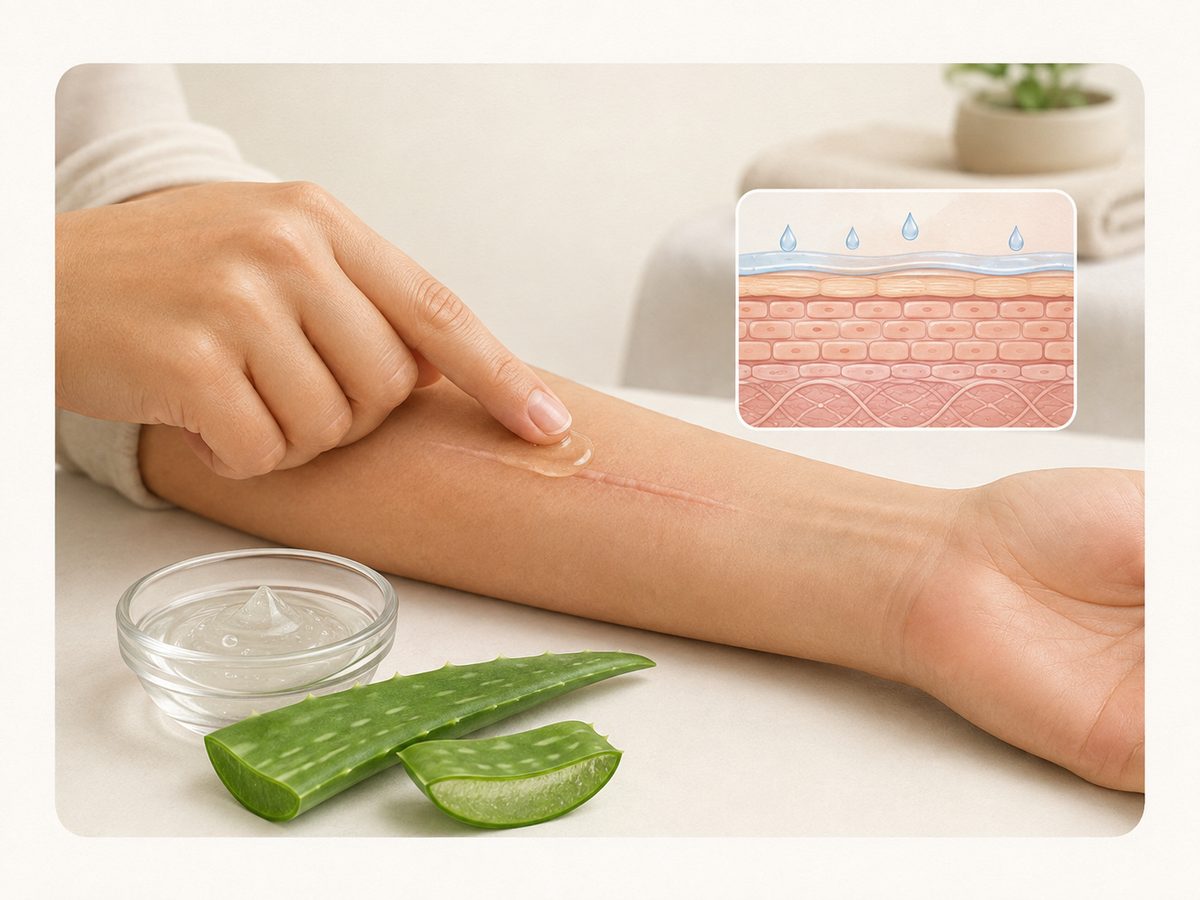
Does it work?
A few home approaches earn their place: silicone, available over the counter, daily SPF 30 or higher, and petroleum jelly on a fresh wound. Aloe vera has moderate support for wound healing and pigment, and onion extract is moderate at best. Rosehip is limited: two small human trials point the right way, but a 2024 review concludes there is not yet enough to recommend it. Honey and black seed oil are weak. The green tea figures often quoted for scars counted acne lesions, not scar appearance, so they say nothing about a scar you already have. Vitamin E is the outlier: in 90% of cases it did nothing or made the scar look worse, and about one user in three developed contact dermatitis. Scar massage has its own page, because the evidence behind it is stronger than anything else on this list and it does not belong filed next to the botanicals.
- Best for
- Supporting a scar that is already healing normally: hydration, pigment, itch and pliability. Not structural change.
- Typical course
- Topical remedies need 4 to 8 weeks before you can judge them. Sun protection runs for a year on a new scar.
- Evidence strength
- Strong for sun protection and for keeping a fresh wound moist. Moderate for aloe. Moderate for onion extract. Limited for rosehip. Weak for honey on a fresh incision and Weak (no trials) on an established scar. Weak (no trials) for black seed oil. Weak for vitamin E. Weak (no trials) for tea tree oil on scars. Weak for cocoa butter and shea butter on stretch marks, on two placebo-controlled trials that found no effect.
- Cost
- Lowest of any category. The larger cost is the months spent on a remedy that may not work.
Which scars it works on
| Scar type | Evidence | Expected result | |
|---|---|---|---|
| Acne scars | Limited | Green tea, diluted tea tree oil and jojoba clay masks help active acne, which prevents new scars. They do nothing for existing pits. | Hub → |
| Burn scars | Limited | Aloe may speed second-degree burn healing by about 4.4 days. Keeping the wound moist and out of UV light changes how the scar matures. Neither substitutes for silicone and pressure garments. | Hub → |
| Contracture scars | Weak | Emollients keep contracture-prone skin supple and comfortable. They do not affect the contracture. Stretching and pressure belong with the burn team, and scar massage has its own page. | Hub → |
| Hypertrophic scars | Weak | Nothing in this category flattens a keloid. Tea tree oil has no robust human trial evidence for keloids. | Hub → |
| Keloid scars | Weak | Nothing in this category flattens a keloid. Tea tree oil has no robust human trial evidence for keloids. | Hub → |
| Stretch marks | Weak | Two placebo-controlled randomized trials found no effect on stretch marks, so cocoa butter and shea butter are graded Weak. They moisturize without removing striae. | Hub → |
| Surgical and incision scars | Strongfor sun protection | Daily SPF 30 or higher on a new scar for the first year has strong support and is the single most worthwhile item on this page. Keeping the wound moist so it does not scab also helps. The botanical remedies do less than silicone on a fresh incision. | Hub → |
How it works
One mechanism holds up here, and it is environmental. Keeping a healing wound moist and covered, and keeping UV off it, changes how the scar matures: a wound left to scab heals worse, and new scar tissue stains permanently in sunlight. Petroleum jelly and daily sun protection therefore carry more weight on this page than anything with a botanical name on the label. Most botanicals claim a second route, anti-inflammatory or antioxidant action, and that is where the evidence thins into laboratory work and small studies. Aloe is the best of them, with moderate support for wound healing and pigment. The mechanical route, load applied to tissue by hand, is real and better supported than any of this, and it has its own page.
What to expect
Nothing goes on an open wound. Once the skin is fully closed, topical remedies go on twice daily and need 4 to 8 weeks before you can judge them. Sun protection is the one item on this page worth doing without argument: SPF 30 or higher on the scar whenever it is exposed, for the first year. Petroleum jelly belongs earlier, on a fresh wound, to stop a scab forming. There is no downtime and no recovery, only the daily discipline. If a remedy has done nothing in two months, it is not going to.
Risks and downsides
Review before treatment
- Vitamin E oil: about 33% of patients in the best-known trial developed contact dermatitis, and inflammation worsens a scar. It is also comedogenic and can trigger breakouts around the scar.
- Undiluted tea tree oil causes contact dermatitis and chemical burns. It has to go in a carrier oil, and it does not belong on an open wound.
- Lemon juice and apple cider vinegar have no clinical evidence for scars and irritate facial skin.
- Applying anything to skin that is open, inflamed or currently being irradiated. Wait for full closure.
- Six months on an unproven remedy is six months of the remodeling window spent.
Compared with the alternatives
vs. Silicone
Silicone is technically a home remedy: over the counter, no clinic needed. It is also the only item in this category with multiple randomized trials behind it, which makes it the first thing to try.
vs. Laser
Home care manages the environment a scar matures in; laser rebuilds the dermis. For a scar that is pitted, stiff or limiting movement, nothing on this page closes that gap.
vs. Retinoid creams
Rosehip oil is popular partly because it naturally contains trace trans-retinoic acid. A dedicated retinoid delivers a known dose with clinical trials attached. The oil is a weaker version of the same mechanism.
Common questions
The evidence says no. In the best-known trial it had no effect or made the scar look worse in 90% of cases, and about a third of users developed contact dermatitis. Only 1 of 6 prospective studies found a benefit from vitamin E used alone. Dietary vitamin E is a separate question; the oil is not recommended on a healing scar.
More than most botanicals. Aloe has moderate evidence for wound healing, pigment and pliability, and one randomized trial found an aloe-and-onion silicone gel comparable to silicone sheets at preventing raised scars and better for softness. Much of the mechanistic work is in animals or small trials, which keeps the rating at Moderate.
Honey has real evidence for wound healing and very little for scars that have already formed. Lemon juice has none, irritates facial skin and increases sun sensitivity. Neither belongs on a mature scar.
It has its own page. Massage is the best-supported non-drug thing you can do to a scar, with a 2025 network meta-analysis ranking it highest for overall quality in burn scars, and filing it beside aloe and vitamin E understated it. The technique, the timing and the limits of the evidence are on the scar massage page.