Surgical scar revision
Revision exchanges a scar for a thinner, better-oriented one. It does not remove it, and on a keloid it fails without an adjuvant.
Does it work?
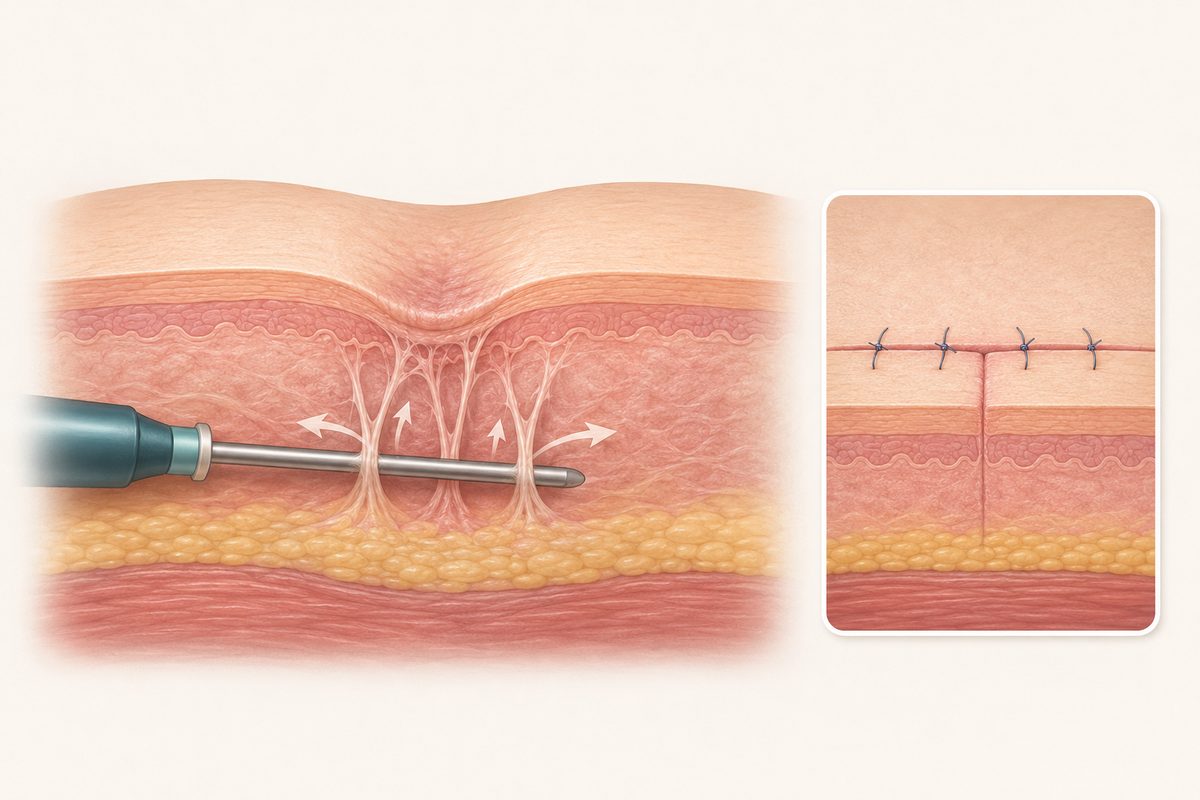
Surgical revision is the option when a scar is a structural problem: wide, tethered, pulled out of line, or tight enough across a joint to limit movement. It reorients or removes the tissue and closes it under less tension. The result is a different scar, never the absence of one. Our corpus grades surgery explicitly in only two places, so most of the tiers below are our reading of the evidence, not a figure lifted from an article. Timing matters more than technique choice: almost every source sets a floor of 12 months, and for keloids excision on its own recurs in 45% to 100% of cases and often returns larger.
- Best for
- Widened, depressed, tethered or misaligned scars, and contractures limiting a joint. Not a first move on anything still maturing.
- Typical timing
- Most of our sources say wait 12 to 18 months. Two C-section articles allow 6 to 12. Nobody recommends revising an immature scar.
- Evidence strength
- Strong for contracture release and for keloid excision combined with radiotherapy. Moderate for elective revision of a widened or misaligned scar.
- Cost
- Our sources disagree. One gives $500 to $2,000 for in-office excision, citing an ASPS average surgeon fee of about $1,950; another gives $1,500 to $5,000 and up for the surgeon's fee alone. A full C-section revision with anesthesia and facility is given as $2,000 to $5,000, and combined with abdominoplasty $8,000 to $15,000 and up.
Which scars it works on
| Scar type | Evidence | Expected result | |
|---|---|---|---|
| Acne scars | Limited | Punch excision has a role for individual deep ice pick or boxcar scars, exchanging a pit for a fine line. It does not treat widespread acne scarring. | Hub → |
| Burn scars | Strong | For contracture and for large areas where grafting is needed. Our sources grade Z-plasty and skin grafting as strong specifically for contractures that limit movement. | Hub → |
| C-section scars | Moderate | The correction for a tethered shelf or overhang, which no cream or laser reaches. It involves layered re-approximation, including closing Scarpa's fascia properly. Wait until you have finished having children. | Hub → |
| Contracture scars | Strong | Release is the definitive treatment once skin length is gone and no amount of stretching or laser will restore it. Z-plasty, W-plasty, grafts, flaps or tissue expansion depending on how much tissue is missing. | Hub → |
| Hypertrophic scars | Strong | Only with an adjuvant. Excision alone recurs in 45% to 100% of cases. Combined with post-operative radiotherapy, pooled recurrence across 106 studies and 10,745 lesions is 14% to 18% depending on the modality. Radiotherapy is usually given within 24 to 48 hours and that remains standard practice, but the same meta-analysis found no significant difference in recurrence between radiotherapy inside 24 hours and later, so a delay is not a lost opportunity. | Hub → |
| Keloid scars | Strong | Only with an adjuvant. Excision alone recurs in 45% to 100% of cases. Combined with post-operative radiotherapy, pooled recurrence across 106 studies and 10,745 lesions is 14% to 18% depending on the modality. Radiotherapy is usually given within 24 to 48 hours and that remains standard practice, but the same meta-analysis found no significant difference in recurrence between radiotherapy inside 24 hours and later, so a delay is not a lost opportunity. | Hub → |
| Surgical and incision scars | Moderate | The core indication. Excision and re-closure for a widened or depressed line, Z-plasty to reorient one that crosses a tension line. A 60-degree Z-plasty gives roughly 75% more tissue length and turns the scar about 90 degrees. | Hub → |
How it works
Revision works on geometry and tension. A scar looks worse when it runs across the natural tension lines of the skin, when the wound edges were pulled apart as it healed, or when the layers underneath were not brought back together. Excision removes the old scar and closes the wound again with the layers re-approximated and the tension taken off the surface, usually with an elliptical excision cut at a 3:1 length-to-width ratio and end angles of 30 degrees or less so the closure lies flat. Z-plasty does something different: it cuts triangular flaps and transposes them, which lengthens the scar and rotates it toward a tension line where it will be less visible and pull less. W-plasty and geometric broken-line closure break a straight line into an irregular one, which the eye follows less easily. For contractures the problem is missing tissue, so the answer is to add it, with a graft, a flap or an expander.
What to expect
Revision is planned around scar maturity. Almost every source in our corpus sets a floor of 12 months, and several extend it to 18, because the tissue is still remodeling before that and operating early produces a worse result. Our articles disagree about when a scar reaches its final strength, with several putting it at roughly 80% by three months. Strength and appearance mature on different clocks, and the wait is about appearance. The procedure itself is usually done under local anesthetic in the office for a small scar, or with sedation and a facility for anything larger. You then repeat the aftercare that applies to any fresh incision: silicone once the wound is fully closed, sun protection for a year, and no tension on the line. The new scar goes through the same 12 to 18 months of maturation as the first one.
Risks and downsides
Review before treatment
- On a keloid, excision alone is close to guaranteed to fail. Reported recurrence runs 45% to 100%, and the returning keloid is frequently larger than the original.
- If radiotherapy is part of the plan, it carries its own risks. Across 106 studies and 10,745 keloid lesions, complications were reported in 9% of X-ray, 18% of brachytherapy and 16% of electron beam cases, mostly local skin reaction and pigment change. A 2026 systematic review of 22 studies found adverse effects were mostly mild to moderate and confined to the treated area, and that a causal relationship between post-operative radiotherapy and later malignancy could not be established. The question has been asked and not answered.
- Any revision trades one scar for another. If the original healed badly because of how you heal, and not because of how it was closed, the new one can behave the same way.
- Standard surgical risks apply: infection, bleeding, wound separation, and a reaction to anesthetic.
- Revising too early produces a worse result than waiting. This is the most common avoidable error our sources describe.
- Our corpus contains no guidance on surgical technique in Fitzpatrick IV to VI. Every skin-tone statement in this cluster is about keloid risk, not about how to operate, so ask your surgeon directly.
Compared with the alternatives
vs. Laser resurfacing
Laser remodels the surface and the dermis. It cannot move tissue, close a gap or restore length. If a scar is widened, tethered or short, laser will improve its color and texture and leave the structural problem in place.
vs. Subcision
Both cut, at different depths and scales. Subcision releases a fibrous band under a depressed scar through a needle puncture and leaves no incision. Revision removes and re-closes tissue. Subcision suits rolling acne scars; revision suits a line that is in the wrong place or the wrong shape.
vs. Steroid injection
For a raised scar, injection comes first and surgery is a later resort. Our sources put excision and injection together for keloids, not against each other, because the injection is part of what stops the excision failing.
Common questions
At least 12 months in ten of our sources, and 12 to 18 in the flagship guides. Two of our C-section articles allow 6 to 12 months, which is the one real disagreement in the corpus. Scars change substantially in the first year, often for the better, and revising before that both risks a worse result and may treat a scar that would have settled.
Documented functional impairment is the argument that works: a contracture restricting a joint, a scar that breaks down repeatedly, or significant chronic pain. Purely cosmetic revision of a stable scar is generally out of pocket. Photographs and a specialist letter are typically required.
Because the incision is a fresh wound in skin that already overreacts to wounds. Excision alone recurs in 45% to 100% of cases and often returns larger. With radiotherapy started within about 24 to 48 hours of closure, recurrence falls to roughly 20% overall and as low as 0% to 8.6% in controlled trials.
No. It exchanges the scar for one that is thinner, flatter, better aligned or shorter. A well-executed revision produces a line that no longer catches the eye or restricts movement, and the tissue is still scar.