CO2 Laser Scar Removal: Is It the Gold Standard?
CO2 laser is one of the most widely used and clinically studied scar treatments available. We break down how it works, what types of scars it treats best, and what to expect.

Is CO2 Laser Scar Removal the Gold Standard for Visible Scars?
CO2 laser scar removal is one of the most clinically studied and widely used treatments for reducing the appearance of scars from acne, surgery, burns, and trauma.
Here is a quick comparison of how it stacks up against other leading options:
| Treatment | Best For | Evidence Level | Downtime |
|---|---|---|---|
| Fractional CO2 laser | Acne, surgical, hypertrophic, burn scars | Strong (multiple RCTs and meta-analyses) | 5-14 days |
| Erbium:YAG laser | Superficial atrophic scars, lighter skin | Moderate | 3-7 days |
| Pulsed dye laser (PDL) | Vascular/red scars, hypertrophic | Moderate | Minimal |
| Microneedling | Mild atrophic scars | Moderate | 1-3 days |
| Steroid injections | Hypertrophic and keloid scars | Moderate | None |
| Silicone gel/sheets | Prevention, early scars | Moderate | None |
| Subcision | Rolling acne scars, tethered scars | Moderate | Minimal |
Visible scars affect far more than appearance. Research consistently links them to reduced self-esteem, social withdrawal, and measurable impacts on quality of life. For many people, that frustration grows when simpler options — creams, gels, massage — produce little visible change.
Fractional CO2 laser works differently from surface treatments. Rather than sitting on top of the skin, it delivers controlled thermal energy into the dermis (the deeper layer of skin beneath the surface), triggering the body's own repair processes to remodel scar tissue from within.
The evidence base is substantial. A meta-analysis of 14 controlled trials involving 492 participants found that fractional CO2 laser therapy produced statistically significant reductions in standardised scar scores (mean difference: -1.19; 95% CI: -1.70 to -0.68; p<0.001). Separate research in burn and traumatic scar populations reports excellent treatment responses in around 60% of patients.
But is it right for every scar type — and every person? The answer, as with most clinical decisions, is nuanced.
Basic co2 laser scar removal glossary:
The Biological Mechanism of Fractional CO2 Laser Resurfacing
To understand why co2 laser scar removal is often considered a benchmark in dermatology, it is necessary to look at the biology of the skin's response to light. The CO2 laser operates at a wavelength of 10,600 nm, which is highly absorbed by the water contained within skin cells.
Modern systems use "fractional" technology, a concept known as fractional photothermolysis. Instead of vaporising the entire surface of the skin (as older "fully ablative" lasers did), the fractional laser creates thousands of microscopic, vertical columns of thermal injury. These are called Micro-Thermal Zones (MTZs).
These MTZs are surrounded by islands of healthy, untreated tissue. This "fractional" approach is the reason for the relatively rapid recovery times seen today; the untreated skin acts as a reservoir of healthy cells that migrate into the micro-wounds to facilitate rapid re-epithelialization, which is often complete within 24 hours.
Deep within the dermis, this thermal energy triggers a cascade of molecular events:
- Fibroblast Activation: Heat stimulates fibroblasts, the primary cells responsible for creating the extracellular matrix and collagen.
- Heat Shock Proteins: Research indicates that proteins like HSP70 peak within 1 to 24 hours post-treatment, acting as signals for tissue repair.
- Collagen Remodeling: The process is biphasic. Initially, there is a downregulation of procollagen, followed by a long-term upregulation. Over approximately six months, disorganized scar collagen is replaced by more orderly Type I and Type III collagen.
- Matrix Metalloproteinases (MMPs): These enzymes are upregulated to degrade the old, "messy" scar tissue, making room for new, healthy fibers.
Scientific research on the mechanisms of CO2 laser in scar treatment suggests that this precise modulation of molecular pathways is what allows the laser to effectively "reset" the healing process in old scar tissue.
Efficacy of CO2 Laser Scar Removal Across Different Tissue Types
Clinical evidence suggests that the success of co2 laser scar removal varies depending on the origin and characteristics of the scar tissue. However, across the board, it consistently outperforms many traditional topical therapies.
In patients with traumatic and burn scars, clinical observations show an excellent treatment response in approximately 60% of cases. Research has also demonstrated a 45.3% drop in scar volume following therapy, a result that significantly exceeds the outcomes of many non-laser interventions.
Clinical efficacy is often measured using the Vancouver Scar Scale (VSS), which assesses pigmentation, vascularity, pliability, and height. In various studies, fractional CO2 laser has been shown to reduce VSS scores significantly, indicating a measurable improvement in both the look and "feel" of the tissue.
Clinical Outcomes of CO2 Laser Scar Removal for Acne
Acne scars are perhaps the most common reason patients seek laser resurfacing. These are typically "atrophic" scars, meaning they represent a loss of tissue. They are categorized into three main types:
- Icepick Scars: Narrow, deep pits.
- Boxcar Scars: Round or oval depressions with sharp vertical edges.
- Rolling Scars: Wide depressions that create a "wavy" texture.
Research on fractional CO2 for acne scars indicates that the laser is particularly effective for boxcar and rolling scars. One study involving 40 patients found that icepick scars improved from an average score of 3.46 to 1.86 after just three sessions. Topographic analyses in similar trials show an average scar depth improvement of 66.8%. While icepick scars are traditionally the hardest to treat, fractional CO2 remains a primary choice because it can penetrate up to 2.5 mm deep to reach the base of these pits.
Long-term Benefits of CO2 Laser Scar Removal for Hypertrophic Tissue
Hypertrophic scars are raised, firm, and often result from an overproduction of collagen during wound healing. They can be itchy, painful, and restrictive to movement.
A study on histopathological changes in hypertrophic scars treated with five monthly sessions of fractional CO2 laser revealed significant structural changes:
- VSS Scores: Improved from 8±0.36 to 5.50±0.34 after six months.
- Collagen Density: The percentage of collagen area decreased from 58% to 41.18%, meaning the "bulk" of the scar was reduced.
- Elasticity: The elastin area percent increased from 0.40% to 2.87%, which correlates with the scar becoming softer and more pliable.
These findings suggest that the laser does not just "sand down" the surface; it fundamentally alters the biological makeup of the scar to resemble normal skin more closely.
Optimal Timing: When to Initiate Treatment
A common misconception is that one must wait for a scar to "mature" (usually 6 to 12 months) before starting laser treatment. Recent meta-analyses have challenged this traditional view.
Evidence suggests that "early intervention" is significantly more effective for surgical scars. A systematic review found that initiating fractional CO2 laser treatment at or within one month after surgery significantly reduced postoperative scars compared to treatments started after three months.
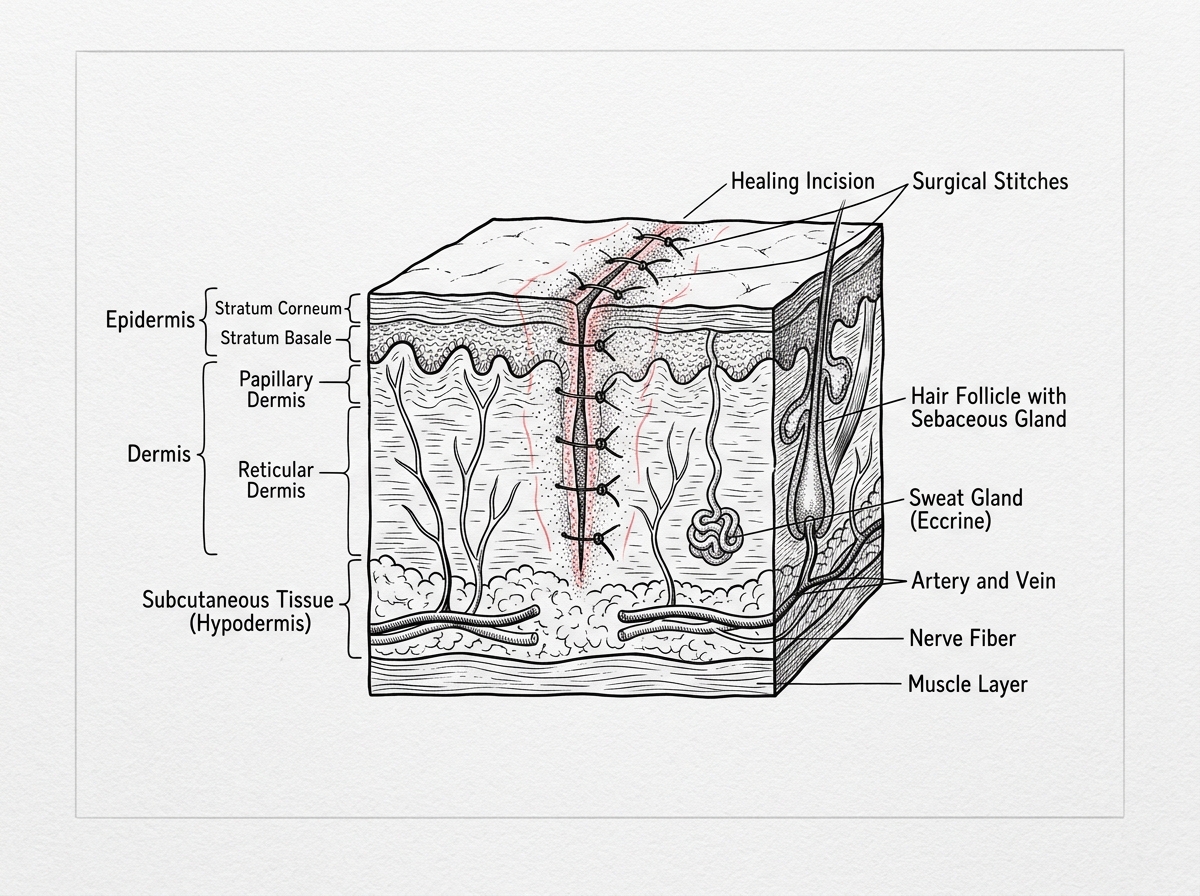
Why does early treatment work better?
- Proliferative Phase: Treating during the proliferative phase (roughly days 4 to 21) allows the laser to influence the collagen as it is being laid down, rather than trying to break down dense, established scar tissue later.
- Vascular Modulation: Early scars are often red (vascular). The laser can modulate the blood supply to the area, potentially preventing the overgrowth of tissue that leads to hypertrophic scarring.
Systematic review on optimal timing for surgical scars highlights that even a single session within that first-month window can produce significant aesthetic improvements.
Comparing CO2 Lasers to Other Scar Management Modalities
While co2 laser scar removal is powerful, it is not the only tool available. Depending on the scar's color and depth, other modalities might be used alone or in combination.
| Modality | Comparison to CO2 Laser |
|---|---|
| Erbium:YAG | Absorbed even more efficiently by water than CO2, leading to less "collateral" heat. It is often preferred for very superficial scars or for patients who want a shorter 3–5 day recovery. |
| Radiofrequency (RF) | Uses electrical current rather than light. It is generally safer for very dark skin tones but often requires more sessions to achieve the same depth of remodeling as a CO2 laser. |
| Silicone Gel/Sheets | The gold standard for prevention. While excellent for keeping a new scar flat, silicone cannot "resurface" a pitted acne scar or break down an old, thick burn scar. |
| Steroid Injections | Essential for keloids and very thick hypertrophic scars. They work by chemically halting collagen production. They are often used before or with CO2 laser to flatten the scar first. |
For complex cases, clinicians often use a "multimodal" approach. For example, surgical scar laser treatment might involve a vascular laser to remove redness followed by a CO2 laser to smooth the texture.
Safety Profile, Recovery, and Candidate Selection
Because CO2 lasers are ablative (meaning they remove tissue), the recovery process is more involved than with non-ablative lasers.
The 7-Day Recovery Timeline:
- Day 1-2: The skin is typically red, swollen, and may "ooze" a clear fluid. It feels like a significant sunburn.
- Day 3-4: Redness persists, and the skin begins to feel tight. Micro-crusting (tiny brown dots) appears where the laser hit the skin.
- Day 5-7: The skin begins to peel or flake off. It is vital not to pick at these flakes to avoid secondary surgical scars.
- Week 2+: Fresh, pink skin is revealed. This pinkness (erythema) can last for several weeks but can usually be covered with mineral makeup.
Candidate Selection and Risks: The primary risk with any co2 laser scar removal is Post-Inflammatory Hyperpigmentation (PIH), which is the darkening of the skin post-treatment. This is more common in patients with darker skin tones (Fitzpatrick types IV–VI). In these cases, lower energy settings, pre-treatment with skin-lightening creams, or alternative lasers like Erbium:YAG are often recommended.
Contraindications include:
- Active skin infections (like cold sores).
- Use of oral isotretinoin (acne medication) within the last 6–12 months.
- A history of poor wound healing or radiation therapy in the area.
For a detailed day-by-day breakdown, refer to this clinical guide on CO2 laser recovery.
Frequently Asked Questions about Laser Scar Treatment
How many sessions are typically required for significant improvement?
While some patients see meaningful change after a single session, most clinical protocols for surgical scars and acne scars recommend 3 to 6 sessions. These are typically spaced 4 to 8 weeks apart to allow the collagen remodeling cycle to complete.
Is the procedure painful, and what anesthesia is used?
Most practitioners apply a strong topical numbing cream (like 5% lidocaine) for 60 minutes before the procedure. During the treatment, patients often describe a "snapping" or "prickly heat" sensation. Afterward, the skin feels hot for several hours, which is managed with ice packs or cooling fans.
Can CO2 lasers be used on all skin tones?
It is possible, but it requires extreme caution. Darker skin types have a higher risk of PIH. For these patients, doctors often use lower "density" settings (fewer laser dots per square inch) and may perform a "test patch" first to see how the skin reacts.
Conclusion
Is co2 laser scar removal the gold standard? For atrophic acne scars and the remodeling of thick, hypertrophic tissue, the evidence suggests the answer is yes. Its ability to penetrate deep into the dermis and trigger a fundamental "reset" of the extracellular matrix makes it more effective than almost any topical or minimally invasive alternative.
However, the "gold standard" is only as good as the timing and the technique. Initiating treatment early — often within the first month after an injury or surgery — appears to be the key to the best possible outcome. Whether you are looking at CO2 laser for surgical scars before and after results or treating long-standing acne pits, realistic expectations are vital: the goal is significant improvement in texture and confidence, rather than "erasing" the scar entirely.
For more detailed insights, you can explore further resources on post-surgical scar healing.
Works Cited
- Zhang, L., Liu, C., & Li, L. (2026). An Overview of the Mechanisms of Fractional CO2 Laser in Scar Treatment. Lasers in Medical Science.
- Ji, Q., Luo, L., Ni, J., et al. (2025). Fractional CO2 Laser to Treat Surgical Scars: A Systematic Review and Meta-Analysis on Optimal Timing. Journal of Cosmetic Dermatology.
- Peng, W., Zhang, X., & Kong, X. (2021). The efficacy and safety of fractional CO2 laser therapy in the treatment of burn scars: A meta-analysis. Burns.
- Petrov, A., & Pljakovska, V. (2015). Fractional Carbon Dioxide Laser in Treatment of Acne Scars. Open Access Macedonian Journal of Medical Sciences.
- Keshk, Z. S., Salah, M. M., & Samy, N. A. (2025). Fractional carbon dioxide laser treatment of hypertrophic scar: clinical and histopathological evaluation. Lasers in Medical Science.
This content is for informational purposes only and does not constitute medical advice. Consult a qualified healthcare professional for diagnosis and treatment.


